Where hospital waste incineration sits on the WHO ladder
Every proposal for hospital waste incineration runs into one question before the equipment is discussed: is an incinerator the right answer for this waste, and if so, which arrangement of it? WHO’s 2019 overview of technologies for the treatment of infectious and sharp waste from health care facilities answers with a hierarchy rather than a catalogue. It sorts the technologies into three tiers, and the tier is decided by the process rather than by the size of the unit.
The tiers come from the Stockholm Convention on persistent organic pollutants, which asks for the option that avoids generating dioxins and furans wherever an equivalent one is available. That is why the ladder reads the way it does: treatment that does not burn the waste comes first, incineration comes next, and incineration reaches the first tier only when the flue gas is treated. Reading hospital waste incineration as a position on that ladder is more useful than reading a comparison of machines.
The three tiers, and what separates them
The first tier holds what the convention prefers: low-temperature treatment such as high-pressure steam autoclaves, microwave units and friction heat, chemical disinfection with sodium hypochlorite, and incineration that is followed by flue-gas treatment. The second tier is a transition position — technologies described as interim, to be improved on rather than settled for: the automatic pressure-pulsing gravity autoclave, the two-chamber incinerator without gas treatment, and the single-chamber furnace. The third tier is uncontrolled burning, which the overview treats as a practice to be eliminated rather than a technology to be specified.
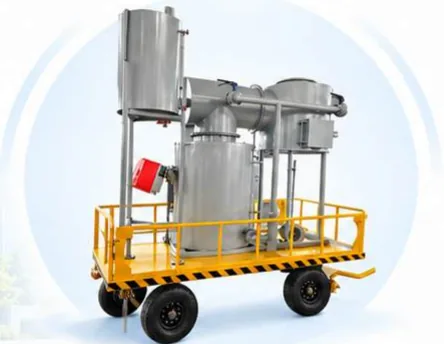
Of the types of incinerators used in hospitals, the two in the middle tier are the two-chamber unit and the single-chamber furnace; the first tier is reached only by a plant with a gas train behind it. Both types of medical waste incinerators in the middle tier share one limitation: nothing stands between the secondary chamber and the stack.
The overview also gives the working capacity of each tier.
- Incineration with flue-gas treatment: 50 to 3,000 kg/h and above.
- Two-chamber incineration without gas treatment: 5 to 500 kg/h.
- Single-chamber incineration: 5 to 50 kg/h.
The first tier: what a compliant incineration plant has to do
The non-burn options are compared in the article on incineration versus autoclave versus microwave; this note stays with the incinerator. Incineration reaches the first tier in one form only: a combustion section that destroys the organic content, followed by a train that cleans the gas before it reaches the stack. The overview divides that into primary measures in the furnace and secondary measures behind it.
- Dioxin and furan emissions no higher than 0.1 ng I-TEQ per normal cubic metre, referred to 11 % oxygen.
- Wastewater leaving the plant below 0.1 ng I-TEQ per litre.
- Primary measures: a primary chamber at 850 °C, a secondary stage at 1,100 °C, auxiliary burners, sufficient residence time, oxygen and turbulence.
- Secondary measures: a flue-gas cleaning train — dust removal, ceramic filtration, a cyclone scrubber, electrostatic precipitation — plus wastewater treatment.
The overview is direct about how often that tier is reached. Very few small and medium incinerators on the market meet it, and a high-technology plant needs a throughput of at least 100,000 tonnes a year before it becomes cost-efficient. That figure describes a central treatment facility rather than a hospital, which is why the overview does not develop the design further. The combustion half of the specification is covered in the article on why incinerators run at 850 °C for two seconds.
The second tier: the dual chamber incinerator and its temperature rule
A dual chamber incinerator splits combustion between two chambers. The primary chamber is held at 850 °C or above by oil or gas burners, and the gas it releases passes into a secondary chamber that brings it to 1,100 to 1,200 °C, the band the overview gives for health-care waste that contains chlorine. Nothing stands behind that secondary chamber: the gas leaves untreated.
The overview gives the working range for the tier as 5 to 500 kg/h on 3 to 65 litres of diesel an hour, on a 220, 230 or 240 V supply, fired on diesel or natural gas. A worked example is a 15 kg charge burned in a 60 minute cycle on about 3 litres of diesel.
The unit is not self-operating. The overview states that a low-automation incinerator of this kind depends on a trained operator who watches the temperature in both chambers, the charging rate and the air supplied to each chamber. That turns a piece of equipment into a staffing and training commitment.
The advantages it lists are real: a large reduction in volume, and a residue that can no longer be recognised. So are the disadvantages — a high environmental and health impact, bottom ash and fly ash that are themselves potentially hazardous waste, and a statement that the arrangement is not in accordance with the Stockholm Convention. Ash from this tier has to be handled as hazardous waste: a dedicated landfill cell, encapsulation into a monofill, or a dedicated ash pit.
The floor of the second tier: single-chamber, brick and drum incinerators
Below the two-chamber unit sits the single-chamber furnace, built of refractory brick and mortar with stainless components and usually fired on biomass. The overview puts its dioxin and furan emissions at up to 400 times the recommended figure, quoting a 2004 study, and gives it a capacity of 5 to 50 kg/h and a service life under five years.
Its justification is narrow: it is acceptable where the only alternative is uncontrolled dumping. The failure list in the overview reads like a maintenance schedule written from experience.
- Operating without pre-heating the unit with biomass, so the chamber runs cold.
- Overloading the chamber beyond its charge.
- Door frames and hinges distorting so the door no longer seals.
- Grate bars warping, breaking or blocking.
- Stack corrosion and slack guy wires.
- Cracking in the masonry and in the mortar joints.
Open burning is not a tier a hospital can plan on
Pit burning and open burning take the last position on the ladder. They have no combustion control, no residence time and no gas train, so none of the parameters the first tier is built around can be held, and the overview treats them as a practice to be eliminated rather than a method to be improved. Its emission list for incineration with no gas treatment at all runs to particulate matter carried as fly ash; heavy metals including arsenic, cadmium, chromium, copper, mercury, manganese, nickel and lead; acid gases; carbon monoxide; and dioxins and furans.
Two entries in that list are easy to pass over. Dioxins accumulate in living tissue and are highly toxic at very low concentrations. And in units that are poorly designed or poorly operated, the overview records that live pathogens have been found in the residue and in the flue gas.
What the ladder means for a hospital buying an incinerator
Nothing in the ladder stops a hospital from running an incinerator. It asks the hospital to say which tier that incinerator belongs to, in the procurement document and in the incinerator hospital waste management plan that follows, and to build the rest of the plan around that answer. Incinerators used in hospitals are often bought on a capacity figure and a site plan with the tier left implicit, and the tier is the one term of the specification that the equipment cannot correct later.
Three consequences follow. Staff have to be trained and named, because the tier depends on a person watching temperatures and charging rates rather than on a control loop. Ash has to have a route, because bottom ash and fly ash are hazardous waste from the second tier and from single-chamber units alike. And monitoring has to exist, because a tier that is claimed but never measured is a claim rather than a system.
How a proposal names the tier is worth reading closely. A two-chamber unit specified as an interim solution for a site with no central treatment facility is doing what it was designed to do; the same unit presented as a compliant installation invites an inspection finding. Units built for this duty are set out in the medical waste incinerator specification, with the gas configurations that follow from the emission standard at the site.
Common mistakes
- Treating a two-chamber unit as a Stockholm Convention installation. The overview states the opposite, and combustion control does not change what leaves the stack untreated.
- Reading the second chamber as the whole specification. The tier is defined by the furnace and the gas train together, and the gas train is the half that is missing.
- Forgetting the ash. Bottom ash and fly ash are potentially hazardous waste and need a disposal route arranged before the first burn.
- Running a small unit without pre-heating, or with an overloaded chamber. Both drop the temperature, and a cold chamber is where the emission figures come from.
- Choosing between sizes on kilograms per hour alone. That figure belongs to a waste and to a cycle, not to a catalogue entry.
- Assuming the operator can be a spare pair of hands. Training and monitoring are named as part of the technology, not as good practice around it.
Self-check before a hospital commits to a tier
- Is the waste described by mass per day, by category and by chlorine content, rather than by the words medical waste?
- Has the tier been named in writing, and does it match how the authority at the site reads the convention?
- Are the temperature of each chamber and the treatment of the gas after the secondary chamber both stated, with the figures attributed to a source rather than to a supplier?
- Is there a documented route off the site for bottom ash and fly ash, with a receiving facility named?
- Is one person responsible for operator training, temperature records and the ash manifest?
- Would the plant still be defensible if the emission claims were tested rather than taken on trust?
A hospital does not have to reach the first tier to run a defensible system, and for most sites a central treatment facility is not there to be reached. What the hospital does have to know is which tier it is in, and to say so. The chamber arrangement, the capacity and the ash route follow from the waste description, the daily mass and the standard that applies at the site — confirmed with the manufacturer for the waste stream rather than taken from a general table.