Medical waste incinerators for clinics, hospitals and laboratories.
Dual-chamber medical waste incinerators that dispose of infectious waste on site, with secondary combustion above 850 °C and a flue-gas treatment stage, sized to your daily waste output and emission standard.
What it is
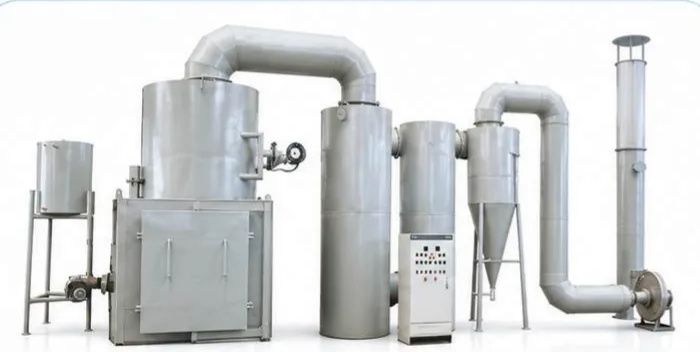
A medical waste incinerator disposes of infectious waste on the site where it is generated, instead of sending it away for collection and treatment. Used syringes, dressings, expired medicines and contaminated disposable supplies are loaded into a sealed primary chamber and burned; the gases released pass into a secondary combustion chamber held above 850 °C with enough oxygen and at least 2.0 seconds of residence time to complete the burn. The range is built as a compact dual-chamber unit that needs only a simple concrete foundation, with a control panel simplified for ordinary clinical staff. Combustion reduces the waste volume by up to 90 % and leaves an inert ash for disposal, and the combustion chambers and the flue-gas treatment stage are supplied as one complete assembly.
How it works
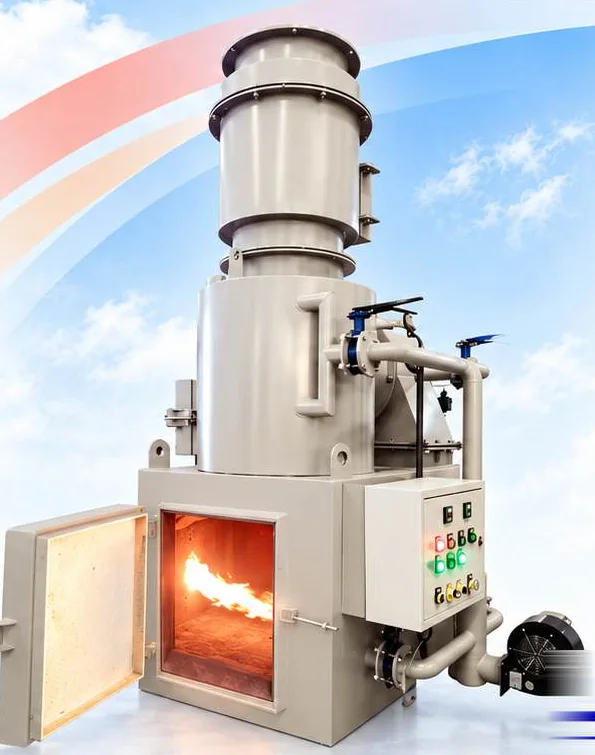
- 1Waste is loaded into the sealed primary chamber through the charging door, and the chamber is kept under negative pressure so gas does not escape during loading.
- 2Primary combustion dries, pyrolyses and partly burns the waste at a controlled temperature, releasing volatile gases and leaving a residual ash.
- 3The gases pass into the secondary combustion chamber, held at or above 850 °C with excess oxygen and a flue-gas residence time of at least 2.0 seconds, which completes the oxidation of harmful compounds.
- 4The flue gas is cooled and cleaned. In the dry configuration it passes through Ca(OH)₂ filter bricks that neutralise acid gases and adsorb pollutants; the wet configuration adds quench cooling, deacidification, activated carbon adsorption and dust removal.
- 5The cleaned gas leaves through the induced draft fan and the chimney, and the residual ash is discharged for disposal.
Combustion figures published for this range: incineration temperature ≥850 °C, flue-gas residence time ≥2.0 s, incineration efficiency ≥99 %. The emission limits and the configuration that applies are confirmed against the regulation in force at the site.
Models and specifications
Published data for the XJY-100 medical configuration. Smaller XJY-30 and XJY-50 units cover lower daily outputs, with dimensional and burner data [to be confirmed with factory].
| Item | XJY-100 |
|---|---|
| Incineration capacity | 100–150 kg/h |
| Unit dimensions (L × W × H) | 2 × 1.4 × 3.5 m |
| Waste feeding inlet | 760 × 960 mm |
| Chimney | OD φ300 mm |
| Induced draft fan | 0.55 kW |
| Auxiliary combustion burner (estimated) | Power 0.15 kW; fuel consumption 4–10 kg/h |
| Re-combustion burner (estimated) | Power 0.37 kW; fuel consumption 7–14 kg/h |
| Operating voltage | 380 V or 220 V |
| Approximate weight | 8,000 kg |
Applications
Hospitals and clinics
Infectious waste from wards, theatres and outpatient departments is treated on site, removing the transport step and the handling risk that comes with it.
Community and rural health facilities
Community health centres, outpatient stations and small private hospitals that have no scheduled hazardous-waste collection service can run their own daily disposal.
Laboratories
Cultures, contaminated consumables and expired reagents from medical and research laboratories are destroyed at source.
Remote and island facilities
Field hospitals, island clinics and sites far from a central treatment plant dispose of waste without depending on a collection chain.
Pharmaceutical and expired stock
Expired medicines and process waste that cannot leave the site untreated are destroyed in the same unit.
Emissions and configuration
The range is offered with two flue-gas configurations. The dry configuration uses Ca(OH)₂ filter bricks after secondary combustion and suits sites where dry scrubbing meets the local limit. The wet configuration adds a multi-stage train — quench cooling tower, deacidification tower, activated carbon adsorber and bag dust collector, with a venturi scrubber and cyclone in the wet-type arrangement — for stricter limits. Which configuration applies is decided by the waste stream and the emission standard at the site, not by the model alone. Fuel can be diesel, natural gas or LPG according to what is available locally.
| Waste basis | Hospital clinical waste (published test basis) |
|---|---|
| Incineration temperature | ≥850 °C |
| Flue-gas residence time | ≥2.0 s |
| Incineration efficiency | ≥99 % |
| Residue loss on ignition | ≥5 % as published [to be confirmed with factory] |
| Operating voltage | 380 V or 220 V |
Emission limits and the applicable test standard are confirmed per project against the local regulation. Values that carry a placeholder are not published for this model and are [to be confirmed with factory].