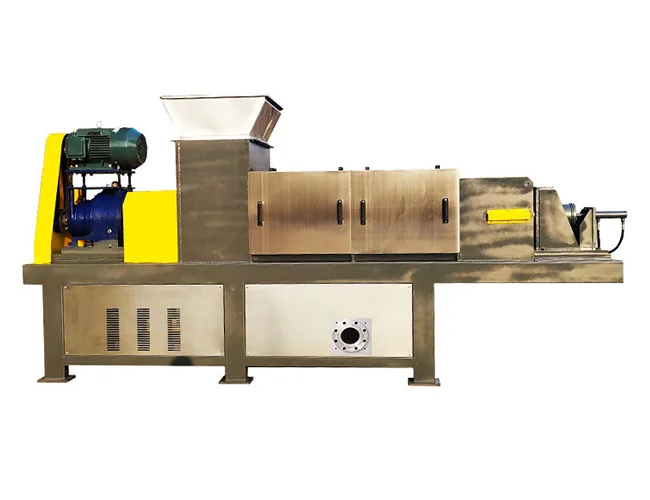
Sludge moisture content is a transport number before it is a process number
A dewatered cake is mostly water. At 80 % moisture content, four fifths of the mass leaving the plant gate is water that has already been treated, pumped, dosed and pressed, and will now be driven to a disposal site and paid for again on arrival. Sludge moisture content is quoted as the share of the cake mass that is water, so a lower figure means less water and more solids in the same tonne of material. That one figure fixes the mass of the cake, and the mass of the cake fixes nearly everything downstream of the dewatering unit.
The plant cannot choose to stop producing solids. It can choose how much water travels with them, and the range it can choose from is set by the dewatering route and by the sludge rather than by wish. The arithmetic below is the reason the choice is worth arguing about.
Take a plant producing one tonne of dry solids a day, which is a convenient unit because it does not change with the dewatering result. At 80 % moisture the cake mass is five tonnes; at 65 % it is about 2.9 tonnes. Roughly 2.1 tonnes a day, more than 40 % of the mass that would otherwise be loaded and driven, stops existing as something to transport. Over a year of operation that is of the order of 780 tonnes of material avoided. The figure depends only on the dry solids and on the two moisture contents, so it holds whatever the local prices are; read it as a worked method rather than as a specification for your plant.
The two figures, and the one a guarantee is written on
Sludge moisture content is not the same as dry solids content, and the two are complements: 80 % moisture is 20 % dry solids, and 65 % moisture is 35 % dry solids. The dry solids figure is the one a dewatering guarantee is usually written on, because it is the quantity the plant produces and cannot change, while the moisture figure is the one that decides the mass and therefore the sludge transportation cost and the gate fee.
Both figures are averages, and that matters more than it sounds. A cake at 80 % moisture on average and a cake that swings between 75 % and 85 % produce the same annual mass and a different transport contract: a tanker is loaded to a mass limit or a volume limit, whichever binds first, and a wet load reaches the mass limit with the tank still part empty. Consistency is worth paying for separately from dryness, and a contract that does not distinguish them pays for it twice.
How a change in sludge moisture content becomes a cost
The calculation has five steps, and only the last of them needs a price.
- Fix the dry solids production in tonnes per day. It comes from the plant rather than from the dewatering result, so it is the same for both cakes.
- Convert each moisture content into a cake mass: cake mass equals dry solids divided by one minus the moisture content, with the moisture content written as a decimal.
- Subtract one cake mass from the other to get the mass avoided per day, then multiply by the number of days the plant operates in the year.
- Convert the mass into trips. This is where the volume of the container, the mass limit of the vehicle and the road rules of the jurisdiction decide, and the answer differs between countries.
- Apply the unit costs that belong to the site: transport per trip or per tonne, plus the gate fee, which in most jurisdictions is charged per tonne of material received and is therefore charged again on every kilogramme of water still in the cake.
Notice what is not in the list: a price. Nothing in the arithmetic is specific to a country, and the two figures a quote turns on, the transport rate and the gate fee, are the two the site has to supply. What the calculation does supply is the multiplier, which is the mass of material avoided for every kilogramme of water taken out at the press. The sludge disposal cost of the drier route is that mass multiplied by the two local rates.
What limits how dry a cake can be made
Lower moisture is not free and it is not unlimited. Water in sludge sits in four places: as free water between the flocs, as interstitial water held in the floc structure, as water bound to particle surfaces, and as water inside the cells. Mechanical dewatering removes the first two and part of the third. The intracellular fraction does not come out under pressure at all, and no press or centrifuge will reach it without a thermal step.
- Sludge type: a mineral, granular primary sludge dewaters further than a light, hydrated biological sludge, and a mixed sludge sits between the two.
- Conditioning: polymer type and dose decide how much of the free and interstitial water can be released, and the dose is set on the sludge in hand rather than on the machine.
- Machine type and running pressure: a screw press, a belt press, a plate-and-frame press and a centrifuge each reach a different band on the same sludge.
- Feed consistency: a machine fed a thin sludge produces a wetter cake, so the thickening stage ahead of it sets the ceiling the dewatering stage can reach.
- Disposal route: where the receiving site charges per tonne and dries the cake again on arrival, the moisture figure moves cost from one party to the other rather than removing it, and it is worth checking which.
Sewage sludge dewatering: where the last points come from
The gap between 80 % and 65 % is not the same job as the gap between 65 % and 60 %. The first is a matter of conditioning and machine selection on most sludges; the second is bought with dose, pressure and machine time, and on a soft biological sludge it may not be reachable by mechanical means at all. In sewage sludge dewatering the usual sequence is to take water out in two stages rather than one, because removing it before the press is cheaper per kilogramme than removing it in the press.
Two constraints bound the choice, and they pull in opposite directions often enough to be worth stating. The first is commercial: where the disposal site charges by mass, dryness pays, and where it charges a flat rate per load, the gain is in trips rather than in tonnes. The second is the plant itself, because the water taken out at the dewatering step returns to the head of the works as filtrate or centrate, carrying solids, ammonia and phosphorus. A drier cake concentrates those loads into a smaller volume of return liquor, and the biological stage is where they have to be treated.
The dewatered sludge cake is a product with a specification
Once the cake leaves the dewatering unit it stops being process water and becomes a material with a contract: a mass, a moisture range, a consistency and, where it is spread on land, a set of quality limits. Freight and gate fee are charged against those properties rather than against the treatment the plant performed, which is why a few points of moisture weigh more heavily in the commercial conversation than in the process design.
It also explains a common disagreement. A plant measures its cake and finds one number; the receiving site measures the same load and finds another. Sampling point, sample size, drying method and the time between sampling and weighing each move the figure by a few points, so the contract needs to say which method is used before it needs to say what the number is.
Common mistakes
- Comparing quotes on the transport rate and forgetting the gate fee, which is the part charged per tonne and therefore scales with the water left in the cake.
- Setting a dryness target without checking whether the sludge can reach it. A target that is out of reach on the sludge in hand is paid for in polymer and machine time and still missed.
- Quoting a moisture figure without saying whether it is a daily average, a spot sample or a contractual figure, and whether it is on a wet or a dry basis.
- Forgetting the return load. A drier cake means a more concentrated filtrate going back to the head of the works.
- Sizing the transport on the plant flow rather than on the cake mass, which changes whenever the dewatering result changes.
- Leaving seasonal variation out. Sludge quality and dewatering performance move through the year, and a contract built on the strongest month is short of capacity in the weakest.
Self-check before the next disposal contract
- Is the dry solids production stated in tonnes per day, separately from the cake mass?
- Are both moisture figures in the comparison stated on the same basis and measured by the same method?
- Has the cake mass been computed at both moisture contents, and the annual mass avoided calculated from them?
- Is the transport figure expressed per trip or per tonne, and has the binding limit of the vehicle and the container been identified?
- Is the gate fee charged per tonne, and has it been applied to both cases rather than to one?
- Has the achievability of the drier cake been confirmed on the actual sludge rather than assumed from a machine table?
- Has the extra load in the return liquor been counted where the biological stage has to treat it?
From a moisture figure to a machine that reaches it
The arithmetic above fixes what a point of dryness is worth at this site; it does not say which machine will deliver that point on this sludge. The sludge dewatering equipment pages set out what a screw press, a belt filter press and a plate-and-frame press each reach on a given feed, and the guide to selecting sludge dewatering equipment works from sludge type, volume and target cake to a machine. The article on sludge drying beds and mechanical dewatering covers the route decision where land and climate are part of the answer. The cake moisture your sludge will reach, and the polymer dose it takes to get there, are confirmed with the factory for your sludge type and your target dryness rather than read off a general table.