What grit is
Grit is the fraction of the incoming flow that is dense, largely inorganic and will not break down: sand, gravel, cinder, glass, eggshell, seeds and the heavier food waste. What makes it grit is its settling velocity rather than its size: it falls much faster than an organic particle of the same size, and that difference is what the process works on. The design figure usually quoted is removal of particles down to about 0.2 mm with a specific gravity near 2.65, read as a starting method rather than as a specification, because the size distribution in a real sewer is site-specific.
Grit is not the same duty as screening. A screen takes out what is large, what floats and what tangles — rags, wipes, sticks — and it does so by size. Grit removal takes out what is dense and small, by settling velocity. The screens and microfiltration page covers the first duty; this article covers the second.
How much grit a plant will see cannot be read from a national figure. A separate sewer serving housing produces a fraction of what a combined sewer in a city that sands its roads produces, and construction upstream can multiply it again. The practical answer is to measure it: record the grit taken out per volume treated over a full year, and size the handling equipment for the higher figure.
Why grit removal in wastewater treatment comes first
A plant can run for years without a grit chamber and still meet its discharge limits. Grit removal is nonetheless placed at the front, because what a plant cannot do is avoid paying for the grit somewhere else. The costs arrive in five places.
- Pumps. Grit is abrasive: it wears impellers, casings and mechanical seals, and shortens the interval between overhauls on the pumps that carry the whole flow.
- Tanks and channels. Grit settles wherever velocity falls: channel bends, the floor of an aeration tank, the corners of a basin. The volume it occupies is paid-for treatment volume that cannot be used, and removing it later means putting the tank out of service.
- Sludge lines and digester volume. Grit travels with the sludge and accumulates in a digester until the digester has to be cleaned out, which is expensive and takes the unit off line.
- Dewatering equipment. Filter cloths, scrolls and belts do not tolerate sand, and the failure mode is wear rather than a warning.
- Disposal. Grit that has been taken out still has to be handled and disposed of, and grit that is mostly organic matter and water is volume you pay to move twice.
The last point is why removal has to be followed by washing or classifying: a grit bin that smells and is half organic matter has put several times its own weight of organic material into a skip.
Where a grit chamber in a wastewater treatment plant sits
A grit chamber in a wastewater treatment plant belongs to the headworks, and its position is decided by two things: it has to be in front of the equipment it protects, and where the flow still has enough energy to be controlled. The usual sequence is coarse screening, fine screening, the grit chamber, flow measurement, then the process train. Where the flow has to be lifted from an inlet chamber, the grit chamber goes in front of those pumps if the layout allows.
Two consequences follow. Taking grit out upstream of the pumps changes the pump selection, and where grit cannot be removed first the pumps have to tolerate it. The headworks is also one hydraulic design rather than three: screens, grit chamber and flow measurement share one channel, one water level and one set of velocities, and a change to any of them moves the others.
Aerated grit chamber in wastewater treatment, and the alternatives
The chamber types differ in how they keep grit settling while holding the organic matter in suspension.
- Horizontal-flow grit chamber. A long channel with a controlled velocity and a grit hopper at the far end. The velocity must be low enough for grit to settle and high enough to carry organic solids through, a narrow band the flow keeps pushing out of.
- Aerated grit chamber in wastewater treatment. Air released along one side rolls the flow into a spiral, so grit is thrown to the outside and settles while lighter organic matter is carried on. The air also washes the grit. The air rate has to be set for the flow: at the wrong rate the chamber either carries grit through or settles organics with it.
- Vortex grit chamber. The flow is made to rotate in a conical basin, and grit concentrates at the bottom, from where a small amount is drawn off. The designs in common use put few or no moving parts below the water line, which is why they are popular on unattended sites.
- Detritus tank, and combined units. A grit chamber and a classifier in one unit, or screening and grit removal in a single fabricated channel. Often the right answer where the headworks has to be compact or has to arrive as a package.
The choice follows from the range of flow, the grit expected and the operator attention the site can give, not from which type is commonest: a chamber needing a velocity controller, a grease scraper and a daily check is a poor fit for a site with nobody on it.
Sizing a grit chamber, and the two velocities in tension
The premise of grit removal is a compromise the design has to state: take out the dense particles down to a chosen size, and carry everything lighter through to the biological stage. Two velocities are in tension. Too slow, and organic solids settle with the grit and the handling system gets a load it cannot wash; too fast, and grit carries straight through and the chamber does nothing.
Figures usually quoted for a horizontal-flow chamber are a horizontal velocity of the order of 0.3 m/s with a detention time of the order of 40 to 60 seconds. Read them as a starting method rather than as a specification. They describe a chamber handling a flow near its design value: at half that flow the velocity halves, organic matter settles, and the chamber performs worse than at the peak. That is why the peak, not the average, is the figure a chamber is checked against, and the peaking factor chart covers how an average becomes a peak.
How to determine the figures for a site: settle a sample of the material arriving at the headworks and read the size distribution and specific gravity from it. Where the sewer is unusual — a combined system carrying road sand, or a catchment with construction upstream — that measurement changes the answer more than any table does, and the removal mechanism, hopper slope and classifier are then sized on the same figure.
The wastewater headworks as one duty
The wastewater headworks is the one place in a plant where the flow is still raw and nothing downstream has been protected yet. Screening, grit removal, grease removal where it is needed, and flow measurement are usually treated as one design, because they share the same channel and water level, and because the failure mode of each is a load passed to the next. The bar spacing of a screen changes what reaches the grit chamber; the floor level of the chamber changes the head available to the rest of the plant.
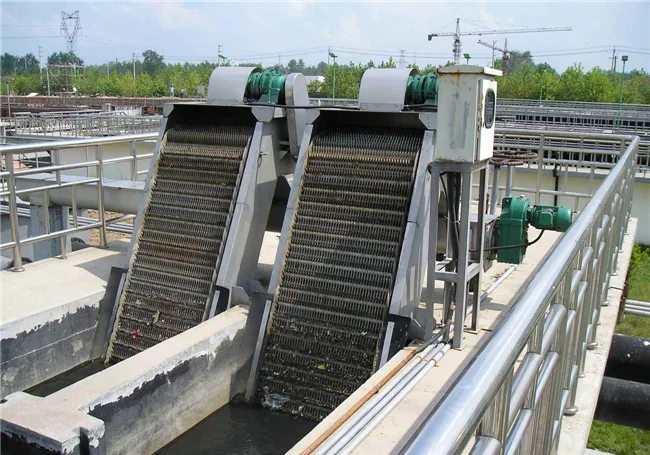
Where the headworks has to be compact, or to arrive as a factory-built unit, the duties are often combined in a single fabricated channel. The screens and microfiltration page describes the screening side of that arrangement, including the mechanical bar screen and the rotary microfilter behind it.
Common mistakes
- Sizing the chamber on average flow. It is least effective at low flow, where organic matter settles, and least protective at high flow, where grit carries through.
- Treating grit removal in wastewater treatment as screening. The two duties take out different material, and a chamber designed as a screen does neither job.
- Leaving washing and classification out of the scope. Grit that leaves with the organic matter in it is volume, odour and disposal cost.
- Designing the chamber without the grit handling equipment: the classifier, the drainage, the skip and the room to work.
- Ignoring grease: it arrives with the grit, coats the removal mechanism and the classifier, and needs a decision of its own.
- Taking a grit loading figure from another project: sewer type, road sanding and upstream construction move it by a factor rather than a percentage.
- Forgetting maintenance access, when a grit chamber is one of the few units a plant expects to be opened and emptied.
Self-check before the chamber is fixed
- Is the peak the chamber is checked against the peak of this plant?
- Has the low-flow case been checked as well as the high-flow case?
- Is the removal target stated as a particle size and a specific gravity, not as a chamber type?
- Is the grit loading figure based on this sewer and measured rather than assumed?
- Is the grit chamber in a wastewater treatment plant upstream of the pumps it protects, and if not, are the pumps selected for grit?
- Is the grit washed or classified before it is binned, and is the wash water accounted for?
- Is there a grease decision, and a place for the grease to go?
- Has the wastewater headworks been checked as one hydraulic design, in terms of the head it costs the rest of the plant?
From the headworks to the process train
The headworks exists to hand the process a flow it can treat: no rags, no grit, no grease, and a rate the next unit can take. The screens and microfiltration page covers the screening duty, the sedimentation pages cover the settled-solids duty behind it, and the plant selection and sizing guide takes design flow and discharge standard and turns them into a train. Where the whole headworks is bought as one fabricated unit, the chamber arrangement, the grit handling duty and the wash water needed are confirmed with the factory for your design flow and sewer type rather than assumed from a table.