What a sludge drying bed is, and what it asks of the site
A sludge drying bed works by drainage and evaporation and needs neither chemical nor machine. It is a shallow, underdrained basin filled with graded sand over gravel, divided into beds, and fed with a layer of liquid sludge. Water leaves by two routes at the same time: it drains downward through the sand into the underdrain, and it evaporates from the exposed surface. What is left is lifted off after a period measured in weeks. There is no polymer, no press, no centrifuge, and no power beyond the pump that delivers the sludge onto the bed.
The consequence is that the bed is paid for in a currency most sites hold in some quantity and few hold in unlimited quantity: ground area. A bed has to hold the solids the plant produces between one harvest and the next, and the number of harvests a year the climate allows. Both of those are properties of the place rather than of the equipment, which is why two beds carrying the same solids duty on two sites can differ in area by a wide margin.
Sludge drying bed design therefore starts from the local record rather than from a catalogue: annual dry solids production, the evaporation and rainfall of the site, the number of weeks in the year the bed is workable, and the depth of sludge that can be applied before the surface seals and stops draining. Those inputs produce an area, and the area is what the site has to be able to spare for the life of the plant.
Published allowance figures for bed area per person, or per kilogramme of dry solids per year, come from a particular climate and a particular sludge. They are useful for an order-of-magnitude check and should be read as a starting method rather than as a specification, because the figures that govern are the evaporation and rainfall record of the site and the behaviour of the sludge in hand.
Sludge drying beds in wastewater treatment: the conditions they suit
Beds did not survive into modern practice by accident. On some sites they remain the cheapest route per tonne of dry solids over a plant life, because the running cost is a mechanical lift and an occasional sand top-up rather than polymer, power and maintenance. Those sites share a recognisable set of conditions, and a site that does not match them will regret the choice in the second wet season.
- A warm, dry and windy climate with low rainfall during the drying season: the cycle is short and the area required is smaller.
- Land that is genuinely available for the life of the plant, at a cost that does not have to compete with a future expansion of the treatment works.
- A small plant, or a plant with a seasonal population, where the solids quantity does not justify a machine and its maintenance routine.
- A site that can use a dry, crumbly cake directly, without a drying or storage step on the receiving side.
- Labour available for a periodic harvest, since emptying beds is a campaign that happens a few times a year rather than a continuous duty.
- A remote site with unreliable power, where a machine that needs a pump, a polymer make-up unit and a control panel is a liability rather than an asset.
Rainfall during the drying period is the more damaging of the two weather variables. Rain re-wets the cake and can push the cycle back by days at a time, which is why many beds are covered, and a covered bed has a longer cycle than an open one but a far more predictable one. Odour is the second limit: an open bed of sludge is an open surface, and a site close to housing may not be able to use one at all without covering and odour control.
What mechanical sludge dewatering changes
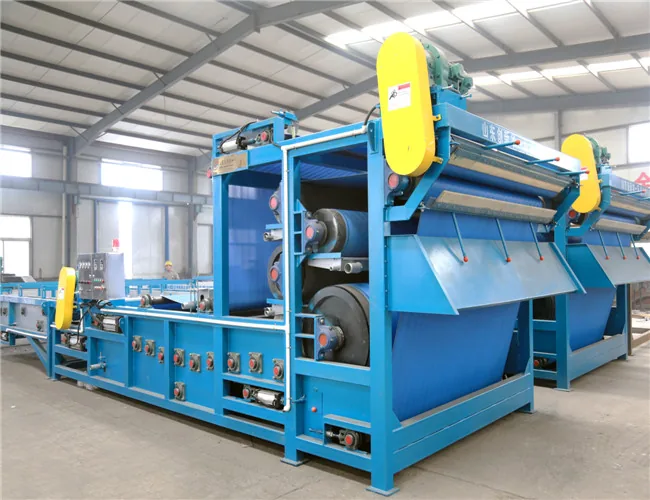
Mechanical sludge dewatering takes the same water out with equipment instead of weather. A belt filter press drains the sludge and then presses it between belts, a screw press conveys and compresses it along a rotating shaft, a plate-and-frame filter press fills chambers and squeezes them hydraulically, and a centrifuge separates by centrifugal force. All four do the job in minutes rather than weeks, in a footprint measured in square metres rather than in hundreds of them, and independently of the weather.
The price is written into the machine. Each of these units needs conditioning polymer, electricity for its drives, a wash-water supply where belts or cloths are sprayed, and a maintenance routine. In return the cake is drier and far more consistent than a bed can deliver, and the operation is continuous and can be automated, which matters where the plant runs to a shift pattern or where the solids quantity is too large for a bed to keep up with.
The consequence is that the two routes are rarely in competition for the same duty at the same size. A bed is limited by area and by the calendar; a machine is limited by its throughput, its polymer consumption and the skill available to run it. Below a certain solids production the machine cannot be justified, and above a certain area requirement the bed cannot be built.
The two sludge dewatering methods, compared where it counts
- Footprint: a bed takes hundreds of square metres for a duty a machine handles in tens, so the site either has the area or does not.
- Climate dependence: the bed works to the weather and the machine does not, so a wet climate turns the bed from an area question into a schedule question.
- Cake solids: the machine reaches a higher and much more consistent dryness, which shortens the transport and disposal step downstream of either route.
- Consumables: polymer and power for the machine, against sand, labour and a periodic harvest for the bed.
- Response time: the machine starts, runs and stops with the plant, while the bed runs to a cycle of weeks and cannot raise its throughput on demand.
- Return liquor: both routes return water to the head of the works, carrying solids and ammonia, and on both routes that load belongs in the biological stage.
- Behaviour in bad weather: a bed that is rained on holds its inventory for weeks, and a machine that stops restarts when the fault is cleared.
- Automation: a plant that must run unattended or to a shift pattern is served by the machine, and a plant that must be cheap to run and can wait is served by the bed.
Common mistakes
- Sizing a bed on the plant flow rather than on the dry solids the plant produces, and on a generic climate rather than the climate of the site.
- Leaving the rainfall of the drying season out of the design, then discovering that the beds are workable for fewer weeks in the year than were assumed.
- Comparing the two routes on capital cost alone. The bed is cheaper to build and often cheaper per tonne over a plant life; the machine is cheaper in the currency a constrained site does not have, which is land.
- Assuming a machine removes the downstream problem. A drier cake is easier and cheaper to move, but it is still sludge and it still has to be disposed of.
- Discounting the return liquor, when the water leaving either route carries solids and ammonia back to the head of the plant.
- Forgetting that a bed needs a second bed. Drying is a batch operation, so a plant that produces sludge every day needs enough beds and enough store to cover the whole cycle.
- Buying a machine the site cannot run: polymer that has to be bought, stored and prepared, power that has to be reliable, and a maintenance routine that has to exist.
Self-check before committing to a route
- Is the duty stated in kilogrammes of dry solids per day, as well as in cubic metres of sludge?
- Is the annual solids production known, and with it the mass the route has to hold between two harvests or two disposal trips?
- Has the site climate been read for the drying season, including the rainfall of that season, rather than taken from an annual average?
- Is there land available for the life of the plant at a cost that does not have to compete with expansion?
- Is the labour for a harvest campaign available, and is there a store for the dried material between campaigns?
- Is the polymer, power and maintenance a machine needs available on the site at the reliability the plant requires?
- Has the return liquor from the chosen route been added to the load the biological stage will see?
- Has the disposal route for the cake been settled, since the dryness the route delivers decides how much of it has to be moved?
From a route to a sized unit
The route decision narrows the field; the machine still has to be sized on a sludge that has been measured, and the bed still has to be sized on a climate that has been read. The sludge dewatering equipment pages describe what each machine does with the feed and what cake it leaves, and the guide to selecting sludge dewatering equipment works through sludge type, volume and target cake in order. The article on sludge moisture content follows the cake downstream and shows what its dryness costs to move. The bed area, the machine model and the polymer consumption that suit your site are confirmed with the factory for your sludge type and your local climate rather than read off a general table.