Three ways to hold the biology
A membrane bioreactor (MBR) keeps the biology in suspension and separates it with a membrane instead of a clarifier; the membrane is a physical barrier to solids and pathogens. A moving-bed biofilm reactor (MBBR) grows the biology as a biofilm on small carriers that are kept moving in the tank, so the biomass is attached rather than settled. A sequencing batch reactor (SBR) does the whole treatment in one tank on a cycle — fill, react, settle, decant — rather than in a continuous flow through separate tanks.
The choice fixes what the rest of the plant looks like: whether a secondary clarifier is needed, how much tank volume is required, and what the operator has to do each day.
Footprint and tank volume
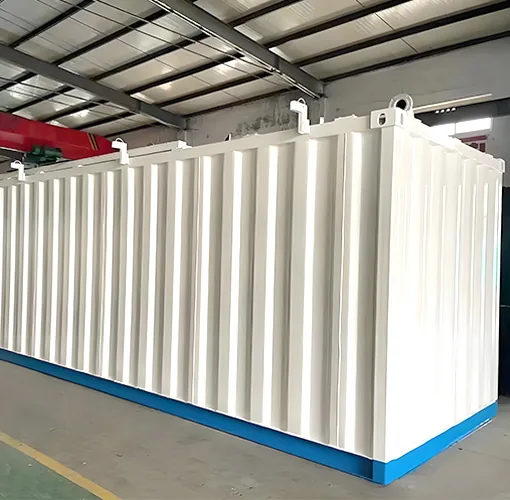
MBR is the most compact of the three, because biological treatment and separation share one tank and the secondary clarifier is omitted. MBR equipment is supplied as packaged units from 0.5–10 m³/h (12–240 m³/day), in footprints from about 3.5 × 1.5 × 2 m to 15 × 2.5 × 2.5 m.
MBBR and SBR generally take more tank volume for the same duty. Tank volume follows V = Q × HRT, and national practice gives 1–2 h of hydraulic residence time for the anaerobic tank and 0.5–3.0 h for the anoxic tank. SBR adds a constraint that is easy to miss: the cycle needs time to settle and decant, so the tank has to be larger than the flow alone implies, and an equalization tank upstream is common.
Effluent quality and what each can reach
The discharge standard usually decides the process before anything else does. Against GB 18918-2002, Grade 1A is the strictest of the grades published on the standards chart: COD 50 mg/L, BOD₅ 10 mg/L, suspended solids 10 mg/L, ammonia-N 5 mg/L and total phosphorus 0.5 mg/L.
An MBR reaches Grade 1A directly, because the membrane retains the solids a clarifier would pass. A conventional A²/O or MBBR train reaches Grade 1A only with advanced treatment after it — coagulation sedimentation, a deep-bed filter and disinfection. Grade 1B and Grade 2 are less demanding, at COD 60 and 100 mg/L and BOD₅ 20 and 30 mg/L, and a simpler A/O train with a secondary clarifier can be enough where only organics are controlled.
Where the water is to be reused rather than discharged, the process moves further still: MBR with disinfection, and MBR with reverse osmosis where a high degree of desalination is required.
Energy use
Energy is where the compactness of an MBR is paid for. The membrane needs aeration to keep it clean and pumping to draw permeate through it, and both run continuously in most designs. MBBR keeps the biology moving with aeration and has no membrane to drive, so its energy use sits between the two. An SBR aerates only during part of its cycle, but the decanting and the cycle control add their own consumption.
The site does not publish an energy chart, because the figures available are industry aggregates with no standard source, and the comparison is left qualitative on purpose. The practical rule is that the process with the highest effluent quality tends to be the one with the highest energy demand.
Operation and maintenance
Two of the three introduce a wearing part that the third does not. An MBR has membranes that need periodic cleaning and eventual replacement, and their performance depends on keeping the biology and the pre-treatment in balance. An MBBR has carrier retention screens, and the carriers have to stay in the tank; a screen failure is a visible problem. An SBR has no membrane and no carriers, but it has decanters and valves that move every cycle, and its control system has to be reliable because the whole plant runs on a sequence.
Operator availability matters as much as the equipment. A plant that runs unattended on a one-button start and stop suits a remote site; a plant that needs daily attention suits a site with trained staff. The choice should follow who will actually be there.
The three processes side by side
The comparison below is not a rating. Each row describes what the process does by virtue of how it holds the biology, and the bands quoted are the ones generally given rather than values for a particular project.
- Footprint — MBR is the most compact of the three, because the membrane takes the place of the secondary clarifier. MBBR needs a clarifier downstream to separate the solids the biofilm sheds, and SBR carries its separation step inside the same tank, so its footprint sits between the other two and it usually needs an equalization tank in front of it.
- Solids concentration — an MBR runs at a high mixed liquor concentration, commonly quoted at 8 to 12 g/L for a submerged unit, because the membrane retains everything and nothing has to settle. An MBBR holds most of its biomass attached to carriers, so the suspended concentration in the tank is a much smaller part of the picture and the carrier fill is what carries the biology. An SBR has to settle its own sludge inside the tank it treats in, which holds its working concentration below what an MBR carries.
- Effluent quality — an MBR reaches the strictest grade on the standards chart directly, because the membrane holds back the solids a clarifier would pass. An MBBR reaches that grade only with advanced treatment after the biological stage, and an SBR reaches nitrogen removal through the control of its cycle; where the strictest grade applies, the SBR shares the MBBR position of needing a tertiary step behind it.
- Operation — the wearing part differs in each case. An MBR has membranes to clean periodically and replace eventually, and its performance depends on keeping the biology and the pre-treatment in balance. An MBBR has retention screens and carriers that have to stay in the tank. An SBR has decanters and valves that move on every cycle, and a control sequence the whole plant depends on.
- Flow range — packaged MBR units are offered from 12 to 240 m³/day and containerized plants up to 360 m³/day. MBBR and SBR usually become the better choice at larger flows, where tank volume and civil cost carry more weight than compactness, or where the discharge standard is loose enough that a membrane is not needed.
Bands of the kind quoted above are the ones generally given in the literature and in operating experience, and they should be read as a starting method rather than as a specification, because the figures that apply to a given plant belong to its water and its biology.
Which process at which flow
At small flows the value calculation often points to MBR. The effluent standards chart notes that MBR omits the secondary clarifier and takes less space, and that while energy use and membrane replacement cost more, at small flows it is often the better value. The packaged ranges offered here cover 12–240 m³/day for MBR and 12–360 m³/day for containerized plants, which are the flows at which most packaged plants are sold.
At larger flows the argument changes. Where the standard is not the strictest and land is available, an MBBR or an A/O train with a clarifier can deliver the required quality with less membrane cost. An SBR suits a site where one tank and a batch schedule are preferable to a continuous train, and where the operator can follow the cycle.