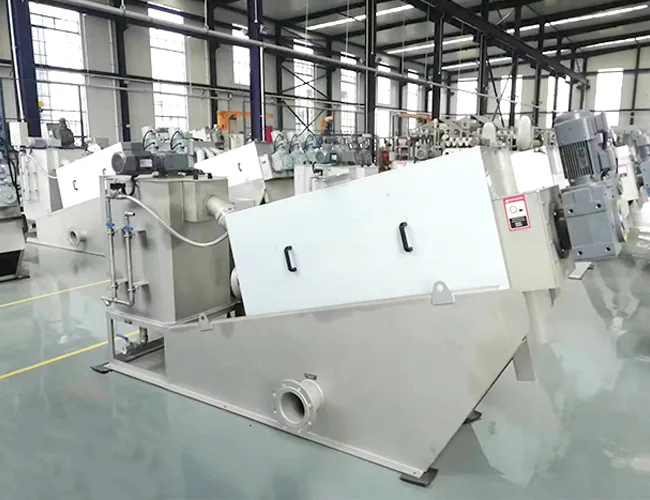
Chemical and advanced treatment.
Oxidation and dosing stages for wastewater that biology cannot break down on its own — Fenton reaction, iron-carbon micro-electrolysis and automatic polymer preparation.
Where chemical and advanced treatment sits in the train
Biological treatment removes most of the organic load from municipal and readily degradable industrial wastewater. Refractory wastewater is different: the organics resist biodegradation, the COD stays high through the biological stage, and colour and long-chain compounds carry through to the effluent. Chemical and advanced treatment breaks those compounds down instead of relying on the biology. Oxidation with Fenton reagent attacks the refractory fraction and raises the ratio of BOD to COD, iron-carbon micro-electrolysis breaks long chains and rings under acidic conditions ahead of the biological stage, and automatic polymer preparation supplies the flocculant the dewatering stage needs. A unit can be placed ahead of the biological train as a pretreatment, or after it as a polishing stage.
CXFD Fenton reactor
The Fenton reaction uses ferrous ions to catalyse hydrogen peroxide, producing hydroxyl radicals that oxidise organic compounds biological treatment cannot degrade. The reactor is run as a fluidised bed: wastewater, reagent and air are mixed in the reaction zone, the iron-bearing carrier stays in the bed, and the oxidised effluent leaves from the top. The process attacks refractory, high-COD wastewater, breaks down part of the organic load rather than transferring it, and improves the biodegradability of what leaves the reactor, so it is used both as pretreatment ahead of a biological stage and as polishing after one.
| Model | Capacity (m³/h) | Reactor size φ × h (mm) | Hydraulic retention time (h) | Air supply | Net weight (t) | Operating load (t) | Wall thickness (mm) |
|---|---|---|---|---|---|---|---|
| CXFD-1 | 1 | 1200 × 1600 | 1 | Yes | 0.5 | 1.4 | 6 |
| CXFD-3 | 3 | 1500 × 2400 | 1 | Yes | 0.94 | 4.83 | 8 |
| CXFD-5 | 5 | 1800 × 2600 | 1 | Yes | 1.15 | 7.25 | 8 |
| CXFD-10 | 10 | 2200 × 3500 | 1 | Yes | 1.84 | 15.14 | 8 |
| CXFD-15 | 15 | 2500 × 3700 | 1 | Yes | 2.23 | 20.40 | 8 |
| CXFD-20 | 20 | 3000 × 3500 | 1 | Yes | 2.63 | 25.96 | 8 |
| CXFD-30 | 30 | 3300 × 4200 | 1 | Yes | 3.40 | 37.60 | 8 |
Values are the factory's standard table; each project is confirmed against the actual build.
CXWD micro-electrolysis reactor
Iron-carbon micro-electrolysis fills the reactor with a mixture of iron scrap and carbon. In acidic wastewater the two form galvanic cells: the iron dissolves and releases nascent Fe²⁺ and hydrogen, and the reactions that follow break long chains and open aromatic rings. The result is a lower COD and colour load and a higher BOD to COD ratio, so the wastewater leaving the reactor is more readily degraded than what entered it. It is normally installed as a pretreatment ahead of the biological stage, where the biology that follows does the rest of the work.
Dimensions, loadings and materials to be confirmed with the factory.
CXJY automatic PAM dosing machine
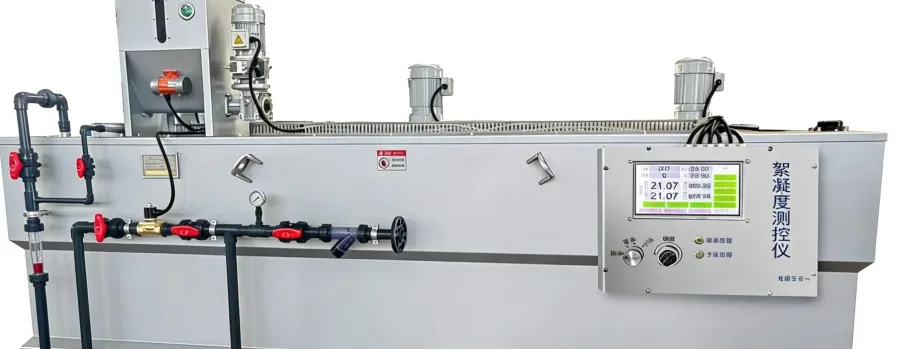
The automatic PAM dosing machine prepares and doses polyacrylamide on site. Powder is wetted and mixed to a working solution in the preparation chamber, held in the maturation tank, and metered into the process by a dosing pump, so the flocculant is freshly made rather than mixed by hand. The preparation capacity spans 1000–8000 L/h and the metering rate is set to match the dewatering load the unit serves. The tanks and wetted parts are built in 304 stainless steel.
| Preparation capacity | Application | Material | Power (kW) | Dimensions L × W × H (m) |
|---|---|---|---|---|
| 1000 L/h | Water and wastewater plants, food and pharmaceutical plants | 304 stainless steel | 2.5 | 1.9 × 0.9 × 1.56 |
| 3000 L/h | Water and wastewater plants, food and pharmaceutical plants | 304 stainless steel | 3.3 | 2.5 × 1.25 × 2.2 |
| 4000 L/h | Water and wastewater plants, food and pharmaceutical plants | 304 stainless steel | 3.3 | 3.5 × 1.25 × 2.2 |
Values are the factory's standard table; each project is confirmed against the actual build.
Applications
High-COD chemical, pharmaceutical, dyeing and electroplating wastewater
Streams whose organic load is largely refractory, so the COD carries through a biological train and the colour and long-chain compounds reach the effluent.
Landfill leachate
Leachate carries a high and variable organic load with poor biodegradability; oxidation and micro-electrolysis bring it into a range a biological stage can handle.
Pretreatment ahead of the biological stage
Breaking down the refractory fraction first raises the ratio of BOD to COD, so the biology that follows removes more of the remaining load.
Polishing before water reuse
After the biological stage, to bring residual COD and colour down before the water goes to a reuse point or to discharge.
Delivery
Units are assembled and tested at our factory before shipment, then shipped with export documentation. Loading arrangement and delivery schedule: [to be confirmed with factory].