Aeration blowers in wastewater treatment: the largest electricity line
A biological process lives on dissolved oxygen, and on an aeration plant the aeration blower is what supplies it. Aeration is usually the largest single electricity consumer on such a plant, and it is commonly quoted at around half of the total, although the share moves with the process, the water depth and the diffuser. That figure should be read as a starting method rather than as a specification: the useful number is the one measured on your own plant, over a period long enough to show a trend.
The same machine is also the single point of failure for the biology. An aeration stoppage is measured in hours before the mixed liquor turns dark and the effluent climbs. Maintenance on a blower is therefore not a housekeeping item that can wait for a convenient week.
What the blower has to do, and why it is not just a fan
A blower has to move a volume of air against a pressure. The pressure is set by the water depth above the diffusers, the losses in the pipework and the condition of the diffusers themselves, not by the blower. That is why the operating point of the whole system, rather than the machine alone, is what decides how much electricity the aeration stage uses.
It also explains the most common misdiagnosis on an aeration plant. As diffusers foul, the pressure needed to pass the same air rises, so the blower delivers less air for more power. The efficiency of the blower looks as though it has fallen, while the real change is downstream of it. Replacing the machine on that evidence spends money in the wrong place.
Which machine suits a duty, a depth and a control arrangement is confirmed with the factory for your tank depth and your diffuser, because the two families behave differently away from their design point. A positive-displacement machine holds flow almost regardless of pressure; a centrifugal machine moves along a curve and is efficient only inside a band, outside which it loses efficiency quickly and can surge.
Wastewater aeration blower maintenance: the routine that prevents failures
- Inlet filter — cleaned or replaced on condition. A loaded filter is a pressure drop the machine pays for continuously, and a torn one lets dust into the clearances.
- Lubrication — oil level and oil condition, at the interval the manufacturer sets for that machine and that duty, not at an interval carried over from another plant.
- Relief valve and non-return valve — checked for freedom of movement. A relief valve that has seized is how a blower is destroyed when a valve downstream is closed.
- Vibration and bearing temperature — recorded as a trend. A single reading either passes or fails; the trend gives weeks of warning.
- Air header, gaskets and flexible connections — leaks on a pressurised header cost air continuously, and they are the cheapest fault on this list to repair.
- The standby machine — run it on a schedule. A blower that has stood still for a year is not a standby; it is an assumption.
Aeration blower efficiency in wastewater treatment: where the electricity goes
- Fouled diffusers. Aeration blower efficiency in wastewater treatment is decided here more often than at the machine, and it is the fault most often charged to the wrong item.
- Over-aeration. A dissolved oxygen setpoint held high for reassurance costs electricity directly, and it can cost again where oxygen carried into an anoxic zone suppresses denitrification.
- Throttling where speed control belongs. Closing a valve to reduce flow leaves the machine consuming nearly full power, while a variable speed drive reduces the power with the flow.
- A centrifugal machine held outside its band, where it loses efficiency and risks surging.
- A control arrangement that does not follow the load. The night-time load of a small plant can be a fraction of the daytime one, and a fixed air rate is the difference left in the bill.
Aeration energy consumption in wastewater treatment: turning it into a number
The measurement list is short enough to be worked through on any plant. Airflow, by thermal mass flow meter or by a pitot traverse in the header. Discharge pressure, at the blower outlet and at the header. Motor power, from a kilowatt meter or from current and power factor. Dissolved oxygen in the aeration tank. And the load the plant is carrying, so that the energy can be expressed per unit of work done.
Two ratios come out of that. Aeration energy consumption in wastewater treatment is best read as energy per kilogram of oxygen actually delivered into the water, and as energy per kilogram of organic load removed. The first says whether the blower, the header and the diffusers are doing their job; the second is the figure to compare between seasons and between years.
The reference to compare against is your own baseline rather than a published benchmark, because a published figure assumes a diffuser type, a tank depth and a load profile that belong to another plant. A plant that measures its own can see a drift inside a month and find the diffuser that caused it.
Dissolved oxygen control in wastewater aeration
Dissolved oxygen control in wastewater aeration begins with the setpoint, which is the cheapest lever on the bill, and with the sensor that feeds it, which is the cheapest item on the maintenance list. A control loop reading a probe that has drifted high trims air the biology needs; one reading low aerates water that does not need it. Cleaning and calibrating the probe, and checking it against a second reading, is a job measured in minutes, and it moves the largest electricity line on the plant.
A setpoint of the order of 1.5 to 2 mg/L in the aerated zone is commonly quoted for a plant expected to nitrify, and as with every band in this article it should be read as a starting method rather than as a specification, because the right value depends on the process, the mixing and the load. What matters is that the setpoint is a decision with an owner, rather than a number left where the commissioning engineer put it.
The control arrangement grows with the plant. A small unit switches the blower on a timer or on a dissolved oxygen signal. A larger one trims a variable speed drive from a dissolved oxygen measurement, and often combines that with a flow-proportional signal so that the air follows the load instead of chasing the probe. The failure mode to watch for is a loop left in manual, aerating at a fixed rate through a weekend of low load.
Blower replacement for wastewater treatment plants: when the money is justified
- Spares have run out. A machine with no available impeller, seal or bearing cannot be maintained, whatever its condition today.
- The duty no longer matches the plant. An added tank, deeper diffusers or a heavier load move the operating point, and a machine at the edge of its band is inefficient and unreliable there.
- A throttled constant-speed machine on a load that varies. Where the flow follows a daily curve, a variable speed machine usually pays for itself on the electricity line.
- A machine whose noise or vibration has become a problem for the site and not only for the machine.
- Electrical compatibility, where a unit was supplied for a different frequency or voltage system than the one it stands on.
The decision should rest on measured energy and on the spares situation rather than on the age of the machine. A well-maintained older blower running at a good operating point can be cheaper to run than a new machine held outside its band, and the measurement that shows which of the two you have is the one described above.
Spare parts, and the shutdown that does not happen
The parts list for a blower is short and predictable: filter elements, oil and seals, belts or a coupling, a relief valve, a bearing set, and the flexible connection at the discharge. On a plant whose biology depends on air, holding them is not inventory practice but process protection, and it is the difference between a repair that takes an afternoon and an outage that lasts until a shipment clears customs.
The same list applies to the instruments the blower is controlled by. A dissolved oxygen probe, its electrolyte and its calibration standard are consumables, and a plant that holds none of them runs its aeration on a sensor nobody can correct. Parts and a replacement blower matched to your model and duty are confirmed with the factory for your unit rather than ordered from a general description.
Common mistakes
- Replacing a blower because the aeration pressure rose, when the diffusers were the fault.
- Leaving the dissolved oxygen probe out of the maintenance schedule, and then managing the aeration bill with a sensor that has drifted.
- Running a machine against a throttled valve for years because the control was never changed to speed control.
- Ignoring the inlet filter until the pressure drop is visible, and paying for it in electricity the whole time.
- Treating the standby blower as a spare rather than as a machine. It has to be run to be one.
- Comparing two years of plant electricity without correcting for load, weather or a change in the diffusers.
Self-check before the aeration bill is accepted
- Are airflow, discharge pressure and motor power of the aeration blowers recorded, or only the dissolved oxygen?
- When were the diffusers last checked, and is the pressure trend separated from the condition of the blower?
- Is the dissolved oxygen probe cleaned and calibrated on a schedule, and is there a spare on the shelf?
- Does the aeration rate follow the load through the day and the week, or is it constant?
- Are the air header and the flexible connections inspected for leaks, and is there a record of it?
- Is the standby machine run on a schedule, and are its spares held?
From the blower to the plant
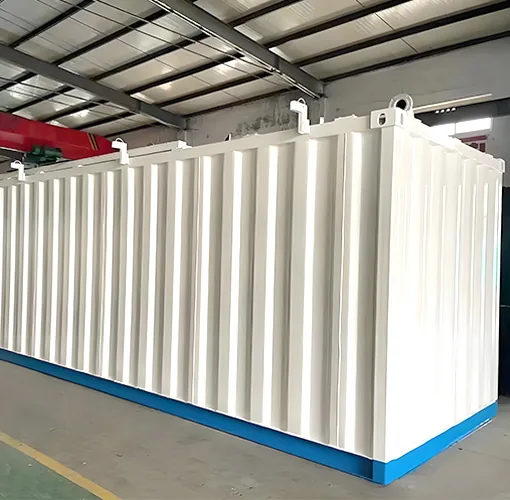
Aeration is where a biological plant spends most of its electricity and where its biology is most exposed, which makes the blower a maintenance subject and a design subject at once. The integrated MBR equipment page sets out how the aeration system, the membrane and the biology are packaged together, and the containerized sewage treatment plant page describes the arrangement in which one blower serves a complete plant. How the aeration rate, the diffuser and the control arrangement are chosen for a particular unit is confirmed with the factory for your tank depth and your load rather than taken from a general figure.