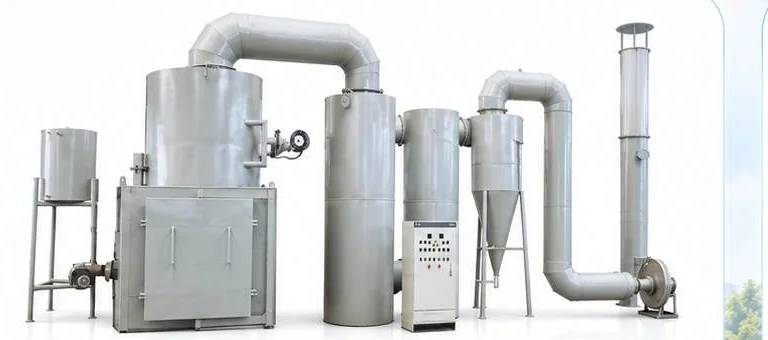
What incinerator flue gas treatment has to remove
What leaves a secondary combustion chamber is not one pollutant but a mixture, and the mixture is what makes flue gas treatment a train of stages rather than a single device.
- Acid gases — hydrogen chloride and sulphur dioxide from plastics, and hydrogen fluoride from fluorinated waste. They dissolve readily, so they are removed by contact with an alkaline liquid or a solid sorbent.
- Nitrogen oxides — formed from the nitrogen in the waste and in the combustion air. Nitric oxide is only slightly soluble, which is why it is dealt with in the furnace rather than by scrubbing.
- Particulate and fly ash — the solids that did not settle out of the gas. Most of the heavy metals travel on this dust.
- Heavy metals — mercury in particular leaves as a vapour, so it needs an adsorbent rather than a filter.
- Dioxins and furans — destroyed in the hot zone, and able to re-form downstream on the surface of fly ash.
- Carbon monoxide and residual organics — indicators of incomplete combustion rather than pollutants a gas train can remove.
Reading that list against the stages is most of the design. A configuration that leaves a group unaddressed does not show up until the stack is monitored.
Cooling: the flue gas quench tower
The gas leaves the secondary chamber hot, and the first stage is normally to cool it quickly. A flue gas quench tower does that evaporatively: water is sprayed into the gas stream and the latent heat of evaporation takes the temperature down, with no heat-exchanger surfaces for dust to foul.
The reason for doing it quickly is the same reason the combustion temperature matters. Between the chamber and the filter the gas passes through a band in which dioxins can re-form on fly ash. The band usually quoted is roughly 200 to 400 °C, and the figure is given to show the direction of the design — cool through it fast, and do not let the gas sit in it — rather than to fix a setpoint.
A quench is a wet vessel, so the water it evaporates has to be supplied and the gas it leaves is saturated. The acid gases also make the condensate acidic, so the tower shell, the sprays and the downstream duct are chosen for that service. Where the plant recovers heat, the cooling may be done in a boiler instead.
Scrubbing: acid gas removal from flue gas
A flue gas scrubber removes the acid gases by contact with an alkaline liquid. In a packed tower the gas rises through a bed of packing while the scrubbing liquid runs down it, and the packing gives the two streams the largest possible surface to meet on. A venturi scrubber does the same at higher gas velocity and takes coarse dust with it. The reagent is an alkali — sodium hydroxide, lime slurry or sodium bicarbonate — dosed to hold the liquid where absorption is efficient.
The liquid is recirculated and bled. The bleed, the scrubber blowdown, is a wastewater stream in its own right, carrying dissolved salts, suspended solids and heavy metals, and it needs its own treatment before discharge. A wet train therefore needs a water supply, a reagent supply and a wastewater route, and a site without those is better served by a dry train.
Dry and semi-dry trains do the same chemistry without a liquid effluent. In a semi-dry arrangement a lime slurry is atomised into a spray dryer absorber; the water evaporates as it reacts and the dry product leaves with the gas. In a dry arrangement a solid sorbent is injected into the duct, or the gas passes through reactive filter bricks. In both, the product and the unused sorbent are collected by the filter downstream, so that filter is part of the reaction as well as the separation.
Nitrogen oxides are the exception in this section. Nitric oxide does not dissolve to any useful degree, so a scrubber that removes hydrogen chloride efficiently will remove very little of it. That removal happens ahead of the gas train instead, by injecting a reagent into the furnace or the hot gas path. The emission chart sets nitrogen oxides with its own limit, because it is a separate problem with a separate answer.
Adsorption: activated carbon before the flue gas bag filter
After cooling and scrubbing, what remains is the part that is neither acidic nor filterable as dust: dioxins and furans, and mercury vapour. Both are captured on carbon, and the commonest arrangement is activated carbon injection — powdered carbon is dosed into the duct upstream of the particulate filter, and the carbon builds into the filter cake so that the gas passes through a bed of it rather than merely alongside it.
That arrangement has a property worth understanding before it is specified: it is consumable. The carbon leaves with the filter ash, so the injection rate is a running cost, and the ash that is discharged now contains the dioxins and the mercury that were captured.
A fixed carbon bed is the alternative, with the gas passed through a vessel of carbon that is replaced or regenerated on a schedule. It is easier to control and to monitor, and it needs more space and a heavier vessel than an injection lance. Both arrangements depend on temperature: adsorption is weaker when the gas is hot, and a gas that is too cold carries wet and sticky dust into the filter. The injection rate and the temperature window that suit your waste are confirmed with the factory for your waste composition.
Filtration: the flue gas bag filter and the stack behind it
The bag filter removes particulate, and with it the heavy metals that ride on the dust. Bags of needled felt on a tube sheet hang inside a housing divided into compartments; the gas passes through the fabric, the dust builds into a cake, and a pulse of compressed air or a mechanical shake drops the cake into the hopper at intervals. The cake does most of the fine filtration, which is why a bag filter is cleaned rather than stripped.
In a dry or semi-dry train this is also where the chemistry finishes. The sorbent injected upstream, and the reaction products it has formed, sit in the cake, and the gas continues to react as it passes through, so the filter is a fixed bed as well as a separator.
The constraint that decides where the filter can sit is the fabric. Every bag material has a maximum continuous working temperature, and the quench or the scrubber upstream has to deliver the gas below it. The gas then passes to the induced draft fan, which pulls the whole train, and to the stack, where the limits are monitored. In the chart of incinerator emissions here, the medical and hazardous waste column sets dioxins and furans at 0.5 ng TEQ/m³ as a measurement mean under GB 39707-2020, and the whole gas train is the equipment that has to hold that number.
Why the order is what it is
- A flue gas quench tower before filtration, because a fabric filter cannot accept the temperature the gas leaves the chamber at.
- Cooling before adsorption, because carbon adsorbs poorly from hot gas and the re-formation window closes only once the gas is cold.
- Acid gas removal from flue gas before the filter in a dry train, so that the reaction product forms where it can be captured.
- Adsorption immediately before the flue gas bag filter, so that the carbon in the cake becomes a contact bed.
- Nitrogen oxides ahead of the train, in the furnace or in a catalytic stage, because scrubbing cannot reach them.
- Carbon monoxide within the combustion design, because it indicates incomplete combustion rather than a scrubbing problem.
What decides the configuration for a site
The three configurations offered on the incinerators here — dry purification, wet purification and the basic single-train arrangement — cover the same four duties with different equipment, and the choice follows from the site rather than from the equipment.
- Waste composition. The chlorine in the waste sets the hydrogen chloride load the scrubber has to neutralise.
- The emission standard that applies. The limit at the stack decides how many stages the train needs, not the other way round.
- Water and wastewater. A wet train needs a water supply, a reagent supply and a route for the blowdown.
- Reagent supply. Lime, caustic and activated carbon all have to be bought and stored, and a remote site should be designed around what it can get.
- Climate. A wet train at a site that freezes needs trace heating, drain protection and a shutdown procedure.
- Operating skill. A dry train with an injection system and a bag filter asks less of the operator than a wet train with a recirculation loop.
Common mistakes
- Buying the gas train against the furnace size rather than against the waste and the limit. The same tonnage of a different waste produces a different gas.
- Specifying a wet train without a home for the blowdown. What the scrubber discharges is a stream the site has to treat.
- Slowing the cooling to recover heat without asking what the gas passes through on the way down.
- Forgetting the ash. What the filter collects contains the metals and the dioxins taken out of the gas, and it has to go somewhere.
- Expecting a flue gas scrubber to deal with nitrogen oxides. It will not, and that limit has to be met in the furnace.
Self-check before the gas train is specified
- Is the waste characterised, at least by chlorine content and by the plastics in it?
- Is the emission standard that applies to the site identified, with the averaging period for each parameter?
- Does every group in the pollutant list have a stage that answers it?
- Is the temperature at the inlet to the particulate filter stated, and matched to the bag material?
- Is the rate of cooling through the re-formation range known, not only the inlet and outlet temperatures?
From an emission limit to a gas train
Everything in incinerator flue gas treatment follows from the waste and from the limit, which is why the configuration is chosen before the equipment list is written. The incinerator pages set out what each purification configuration contains, and the chart of incinerator emissions sets out the limits the train has to meet, parameter by parameter. The combustion side of the same subject is covered in the article on why incinerators run at 850 °C for two seconds. The configuration, the reagent consumption and the filter that suit your waste are confirmed with the factory for your waste composition and the emission standard that applies.