What each route actually does
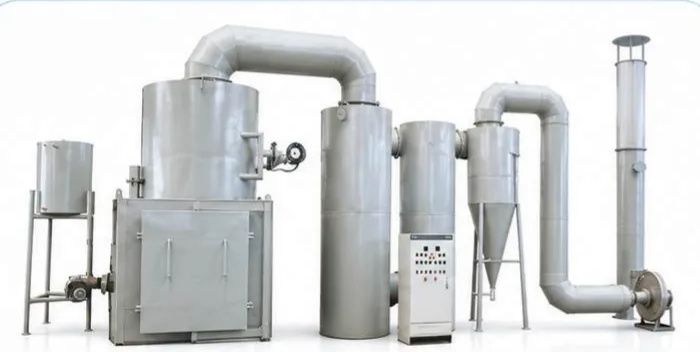
Incineration burns infectious waste at high temperature and leaves an inert ash. The gas from the primary chamber passes into a secondary chamber held at or above 850 °C with at least 2.0 seconds of residence time, and the flue gas is then cooled and cleaned before it leaves the stack. The waste is converted, not stored: the published volume reduction is up to 90% by volume, with the remainder leaving as ash and flue gas.
An autoclave applies saturated steam under pressure — around 121 °C — to the waste inside a sealed vessel. The heat kills bacteria, viruses and other pathogens, and the treated material can then be handled as ordinary waste. What the autoclave does not do is destroy the waste itself. Syringes, gauze and gloves come out of the cycle physically intact and still have to be removed from the site.
Microwave treatment works on the same principle as the autoclave with a different heat source and a different vessel. Moisture in the waste is heated by microwave energy, together with steam, to disinfect the load, and the treated material is usually shredded to reduce its bulk. As with the autoclave, the waste is sterilised rather than destroyed, and it still leaves the site as waste.
Sterilise or destroy: the difference that decides the site
The decisive question is not which route is more effective against pathogens — all three achieve disinfection when they are run correctly. It is what has to happen to the material afterwards. Incineration ends the waste stream at the site. Autoclave and microwave treatment move it one step along: the material becomes non-infectious, and then depends on a collection and disposal route to take it away.
That distinction carries three consequences. A site with no reliable collection service keeps the problem it was trying to solve: sterilised waste still accumulates on the premises when the collection does not come. Sharps are sterile but still sharp, so the stick-injury risk passes to whoever handles the treated material. And in many jurisdictions treated medical waste is still regulated waste, so it needs documentation and an approved disposal route even though it is no longer infectious.
Incineration
Incineration suits a site that has to close the waste loop on its own and cannot depend on a third party to take the residue away — a clinic in a rural area, an island facility, or a hospital whose collection chain is unreliable. It handles the whole stream, including sharps, contaminated plastics and expired medicines that a sterilisation route cannot fully neutralise, and it leaves a small volume of ash that can be disposed of locally.
The costs are equally clear. Incineration needs fuel, so daily operation carries a running cost that steam-based routes do not have to the same degree. It needs the flue-gas treatment train to be part of the unit rather than a later addition, and it needs the space and the ventilation that train implies. The published models span a wide range, from the compact medical waste units to the municipal series published from 50 to 500 kg per hour, so the route can be matched to a small clinic or a larger institution.
A single-chamber incinerator without a secondary chamber is a different machine from the units described here, and it does not meet the same emission figures. Where the specification is incineration, the secondary chamber, the residence time and the gas train are what separate a compliant unit from a bare burner.
Autoclave
An autoclave is the natural choice where the site is connected to a reliable collection service and the priority is to render infectious waste safe before it is removed. It runs on electricity rather than diesel, its initial cost is usually lower than a complete incinerator with a full gas train, and it has no open flame, which some sites treat as a lower fire risk.
The operating conditions are what decide whether it fits. Steam generation consumes a substantial amount of water, and a site with an intermittent supply will struggle to run the cycle reliably. The process also has to be validated and logged if the treated waste is to be accepted downstream, which is an administrative load that a small clinic may not carry. And because the waste remains, the site is still dependent on the same collection route it had before.
Microwave
Microwave treatment sits between the other two in what it needs and what it leaves. It disinfects with moist heat and can be integrated with shredding so that the treated material is compacted as well as sterilised, which reduces the volume of waste that has to be hauled away. It uses electricity rather than fuel, and it avoids the steam vessel of a conventional autoclave.
Its limits follow from the same principle as the autoclave: it treats waste rather than destroying it, so the collection route still matters, and the equipment and its maintenance are more specialised than either of the other two routes. It is a poor fit for a remote site with no service chain and no technical support, and a good fit where the waste is regular, the site has stable power, and the objective is to reduce the risk and the bulk of what still has to leave.
Matching the route to the site
- Is there a reliable collection and disposal route for treated waste? If not, sterilisation routes leave the site with the same problem.
- Does the stream include sharps, contaminated plastics and expired medicines that have to be destroyed rather than disinfected?
- Is water available for steam generation, and is power stable enough for a heat-and-shred cycle?
- Does the local regulation require destruction of the waste, or does it accept sterilised material for regulated disposal?
- Can the site operate and maintain the route it chooses — fuel supply and gas-train maintenance for incineration, cycle validation for steam and microwave?
- What is the daily waste volume, and how many hours a day can the route be run?
The route that answers those questions is the one that fits; the route with the lowest purchase price is not necessarily the one that removes the waste. A site that needs the waste to leave its premises permanently is choosing incineration, and a site with a dependable collection chain and a steady water and power supply has two other good options.