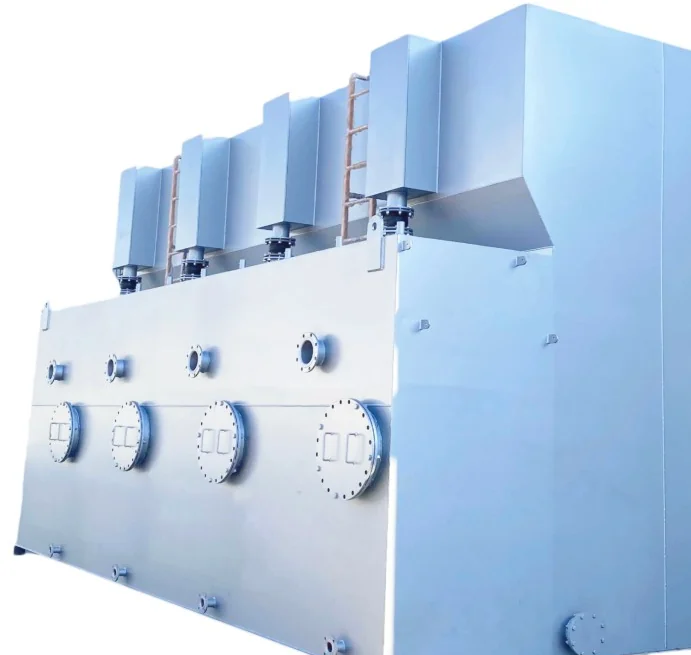
The same duty, three delivery forms
A treatment duty can reach a site in three ways, and the three are often compared as though they were three products. They are better understood as three ways of dividing the same work between a factory and a site. A skid-mounted unit is process equipment mounted on a steel frame: the frame carries the pumps, vessels, valves and control panel, and the site provides the surface it stands on and the shelter over it. A containerized wastewater treatment unit is process equipment built inside a self-supporting enclosure with the dimensions of a shipping container, so the shell is part of the delivered product. Civil works are built where they stand: concrete basins, a plant building and the pipework between them, erected on site by local contractors.
The equipment in all three cases does much the same job. What changes is where the labour happens, who supervises it, and what the site has to be able to do. Workshop work is done by one crew to one set of drawings and is inspected before the unit ships. Site work is done by whoever is available locally, in whatever weather the site offers, on a programme the plant then has to wait for.
One line is worth drawing before the comparison starts. How large the plant has to be and which process it should run is a sizing question, worked through on the plant selection and sizing guide. This article is about the form the plant arrives in once the duty is known.
What each form is good at
Skid-mounted
A skid-mounted water treatment unit makes the most efficient use of shipping volume, because there is no enclosure to pay for or to carry, and it is the only one of the three that can be taken through a normal doorway into an existing building. It suits a duty that is one stage of a larger plant — chemical dosing, a dewatering unit, a filtration stage, a pump station — where the pad, the building and the connecting pipework exist or are being built for other reasons. What a skid does not bring with it is the building. The site provides the level pad, the weather protection where the climate demands it, the drainage, the power and the pipework connections, and the erection that ties them together.
Containerized
A containerized unit arrives weatherproof, with lighting, ventilation, insulation and the control panel already inside the shell. That moves the enclosure into the factory, which is why a containerized wastewater treatment plant suits a site with no workshop culture: the plant needs a pad and the service connections, and very little else. It is also the form that can be lifted onto a truck and moved to a second site, which is what makes it the usual answer for construction camps, mines and island installations. Its limit is the transport envelope. A plant needing more volume than one container holds becomes several container modules linked on site, and the internal width of a standard dry container — the figure the shipping article is built around — decides whether a unit can travel enclosed at all or has to take another route.
Civil works
Concrete basins built on site have no transport envelope at all, and for large tankage that is decisive. Where the water volume rather than the equipment dominates the cost of a wastewater treatment plant — a long residence time, a large equalisation volume, a big aeration tank — a wall poured on site is usually cheaper than steel shipped in a container. Civil works also use local labour and local materials, so the cost advantage grows where both are cheap and the site has room. The trade is time and fixity: the work sits on the critical path in a sequence that cannot be compressed much, from excavation through foundation, concrete and curing before any equipment is set; the quality depends on the contractor; and once built, the plant is where it is.
The boundary conditions that decide it
Six conditions do most of the deciding. They are worth checking in order, because an early one can settle the question before the later ones are discussed.
- Capacity and tankage. Small duties with modest tank volume travel well; duties where water volume dominates the cost favour basins built on site.
- What the site can build. Local contracting capacity, concrete supply and supervision decide whether a civil programme is realistic at all. Where they are absent, the answer is factory-built.
- Programme. A plant that has to be treating water by a date favours modules assembled and tested in a workshop, because concrete is on the critical path from the first excavation.
- Relocation. A packaged wastewater treatment plant that may move — a camp, a mine, a leased site — rules out civil works and points to a container or a skid.
- Installed cost, not equipment price. The comparison that decides money is the cost at the plant boundary: pad, building, transport, erection, pipework, cabling and commissioning.
- Environment and operation. Climate, corrosive air, salt and the availability of maintenance decide how much enclosure and how much on-site assembly the plant can be left to need.
In practice the answer is often a hybrid, and the hybrid is not a compromise so much as the efficient split: civil works for the basins where water volume dominates, and a container or a skid for the process equipment that gains most from factory assembly and testing.
Which one when
- No local contracting capacity, or a schedule that cannot absorb a concrete programme — containerized, factory-built and factory-tested.
- The unit is one stage inside an existing building or an existing plant — skid-mounted, because it can be carried in and set on a prepared pad.
- The flow sits inside the envelope of one container module but may grow later — modular containers, added as the flow grows, each one complete in itself.
- Cheap local labour and materials, plenty of land and a long programme — civil works can be the lowest installed cost, even though the equipment list is longer.
- The plant may have to move — skid or container. Civil works is effectively permanent once the concrete has cured.
- The duty is dominated by tank volume rather than by equipment — basins on site for the volume, packaged equipment for the process stages.
- A harsh climate, salt air or a site with no maintenance culture — containerized, so that the enclosure and the controls are part of the delivered product.
- A fixed discharge deadline or a temporary site — factory-tested modules, because the commissioning period on site is measured in days rather than months.
The list is a starting rule rather than a substitute for the installed-cost comparison. Two of its entries move most often with the project — local labour cost and tankage — and both are answered by pricing at the plant boundary instead of by comparing equipment catalogues.
What the comparison usually misses
- Comparing equipment price only. The invoice for the equipment excludes the pad, the building, the pipework, the cabling, the erection labour and the commissioning. A civil-works plant moves much of that cost into items that never appear in the equipment column, and the two forms are only comparable at the plant boundary.
- Assuming that containerized means it fits a dry container. A standard dry container is about 2.352 m wide internally, and process equipment is frequently wider than that. Transport route is a separate question from delivery form, and it is settled before a freight rate is requested.
- Assuming that a skid is plug and play. A skid still needs a level pad, drainage, power, shelter where the climate requires it, and the interconnecting pipework — all of it the responsibility of whoever prepares the site.
- Forgetting the supply frequency and voltage. Frequency cannot be converted with a transformer, so the drives and the control panel are matched to the site supply before the equipment is built; the power and site conditions article sets out why this belongs in the enquiry rather than in the commissioning visit.
- Pricing the plant without the transport route. A unit that is over height or over width travels as an open-top container, on a flat rack or as break-bulk cargo, and each of those changes the port handling, the lashing and the cost.
- Fixing the delivery form late. A decision deferred until the equipment is ordered turns into a civil programme on the critical path, or into a unit that has to be redesigned to ship.
- Leaving the operator out of the comparison. A site with no maintenance culture and no local contractor is the strongest argument there is for modules that arrive assembled, tested and documented.
Self-check before the delivery form is fixed
- Is the comparison made at the plant boundary, including pad, building, transport, erection and commissioning, rather than on the equipment price?
- Does the largest single piece fit the transport envelope, checked on width first and then on height and payload?
- Is the site supply stated as voltage, frequency and phase together?
- Is there a pad, and is the concrete programme realistic against the date the plant has to be running?
- Who supplies what: which items come from the local contractor and which arrive with the module?
- What does the module need that it does not carry — shelter, water, drainage, compressed air, spares?
- Can the plant be expanded later by adding a module, or does growth mean new civil works?
- Is the option to relocate worth paying for now, or is the site permanent enough to build on?
Sizing first, form second
The delivery form is decided after the duty, not before it. The plant selection and sizing guide takes the design flow, the influent analysis and the discharge standard and turns them into a required capacity; the containerized sewage treatment plant page describes what arrives inside one module and what the site has to provide for it, and how much of your duty a single module covers is confirmed with the factory for your design flow and discharge standard rather than assumed from a table. At the smaller end, the integrated pump stations page covers the same question for skid-mounted equipment. Fixed in that order, the form follows the duty instead of the other way round.