What makes slaughterhouse wastewater different
Slaughterhouse wastewater is a small flow carrying a large load. A kill line uses far less water per unit of product than most wet industries, but what it discharges is concentrated: blood, fat and tissue fines from a process that is essentially the dismantling of animal material in a wet room. The result is a stream whose organic strength is many times that of domestic sewage at a fraction of the volume, and whose character changes with the shift rather than with the clock.
There is good news in the same description. Much of the organic load is soluble and readily biodegradable, which is what a biological process does best. The difficulty is everything else: fat that floats and sets, solids that wrap and settle, blood that is the most concentrated material on the site, and nitrogen that the biology will be asked to oxidise whether or not it was designed to.
Where the load comes from, station by station
- Lairage and animal washing — manure, straw and soil in a continuous wash flow: a low organic load per litre and a high solids content.
- Sticking and bleeding — the blood, the most concentrated stream on the site by a wide margin and the one with the clearest case for being kept out of the drain.
- Scalding, dehairing and singeing — hair, scurf and fine solids in warm water, arriving as a flow that carries material no downstream machine can pass.
- Evisceration — paunch and gut contents with the wash water around them, the source of much of the suspended solids and of a large share of the nitrogen.
- Splitting and trimming — fat, bone dust and tissue fines, in the water used to keep the surfaces and the floor clean.
- By-product and offal handling, and any rendering condensate, which adds grease and a further concentrated organic load.
- End-of-shift clean-up — a day of work washed off the floor in one strong slug of warm water, detergent and solids.
Every stream in that list is produced in a defined window of the shift. A plant sized on the daily average is a plant sized on a curve nobody drew.
Slaughterhouse wastewater characteristics: the five that decide the train
Six measurements decide the pre-treatment train, and all of them are taken on the site in question rather than read from a general figure.
- Blood, and the soluble organic load it carries. Readily biodegradable, and best dealt with by not letting it into the water at all.
- Fat, oil and grease. Solid or semi-solid at ambient temperature, and a problem in pipes, screens and pumps, and on any surface where it can cool and set.
- Suspended solids — hair, paunch, bone dust and tissue fines, each behaving differently and each asking for a different stage.
- Nitrogen, as organic nitrogen and ammonia from blood and gut contents, which becomes the biological load the aeration tank actually carries.
- Salinity and cleaning chemicals — detergents, sanitisers and caustic from clean-up, which move the pH, the alkalinity and the biology.
- The batch pattern, recorded against the clock, because this load arrives with the shift, and the temperature that comes with it.
Blood recovery from slaughterhouse wastewater: the cheapest load to remove
Blood is dense in organic matter, and it is produced at one point, at one moment, by a process the plant already controls. Collected at the bleeding station into a dedicated vessel, it is a by-product with a small volume and a market. Allowed to reach the drain, the same material is diluted into the whole flow of the day and becomes a load the treatment plant pays to oxidise, occupying aeration capacity and producing sludge that then has to be dewatered and disposed of.
Recovery does not have to be complete to be worth doing. A bleeding station that is properly drained, with the wash water kept out of the blood channel, changes the inlet to the treatment plant more than most equipment purchases will. The size of the prize can be established in a week: meter and sample the blood stream on its own, sample the mixed inlet, and compare the two load figures.
Slaughterhouse wastewater pretreatment: screening for hair and paunch
Hair wraps, paunch settles, and both are the kind of material that a pump, a heat exchanger, a diffuser or a membrane cannot pass. A screen is doing work no biological process can do at that particle size: no aeration rate breaks down a bundle of hair within a residence time measured in hours.
Screening is sized to protect what comes after it rather than to reach a removal percentage. A bar screen at the inlet takes the largest material — bone fragments, undigested feed, packaging that arrived with the animals. Fine screening downstream of it is chosen against the opening the next machine can tolerate. What the screen removes is a wet, odorous waste with a handling route of its own, and the fact that it exists has to appear in the design.
Grit removal belongs in the same conversation wherever the lairage and yard drainage share a pipe with the process, because sand and soil do not settle out of a stream with fat in it, and they do not break down either. The article on grit removal in wastewater treatment covers where that stage sits and what it takes out.
Dissolved air flotation for slaughterhouse wastewater
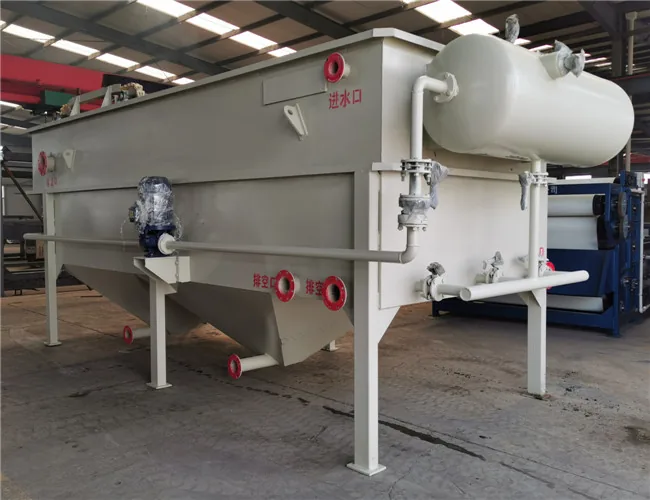
Fat is the hardest of the pre-treatment loads to settle. Some of it floats, some of it is dispersed, and the emulsified fraction settles in neither direction: it passes a settling tank and reaches the biology as a coating on everything. Dissolved air flotation for slaughterhouse wastewater is the stage designed for a load of that kind, releasing dissolved air as fine bubbles that attach to the particles, lift them to the surface, and leave them for a skimmer.
On a stream of this kind the unit is normally run with chemical assistance: a coagulant to destabilise the emulsion and a polymer to build a float that can be skimmed. That combination is what takes out the fat, the suspended solids and a substantial share of the organic load before the water reaches the biology. The dose is not a constant, because it is set on the actual water by a bench test, which is how the jar test described in the companion article earns its place in the train.
Two duties follow the flotation stage and are often forgotten. The float that comes off it is a sludge in its own right, with a volume and a handling route to design; and the chemicals that make the float also add to what the dewatering stage has to process. Both belong in the mass balance rather than in an appendix.
Ammonia in slaughterhouse wastewater: the load pre-treatment cannot lift
Blood and gut contents put nitrogen into the water, and by the time it reaches the biological stage most of it is ammonia from the breakdown of protein. No stage in the list above takes it out: a screen removes solids, flotation removes fat and solids, and dissolved ammonia passes both. The nitrogen therefore has to be designed for, and it decides more of the plant than the fat does.
Nitrification needs a sludge age long enough to hold the nitrifying organisms, an oxygen supply matched to the ammonia load, and alkalinity — because oxidising ammonia consumes it, and a stream already short of alkalinity will fall in pH as it nitrifies. Cold weather is the design case for all three, because the organisms slow down while the load does not. Where the limit covers total nitrogen rather than ammonia alone, an anoxic stage and a recycle have to be in the arrangement from the start.
The way to determine what the biology will be asked to carry is to measure ammonia and total nitrogen at the outlet of pre-treatment across a full week, including the busiest day, and to size the aeration and the sludge age on the worst of them rather than on the mean.
What the biological stage should be handed
- Free of material that can wrap, clog or abrade — hair, paunch, bone dust, packaging.
- Low in fat, so that the biology is not competing with a layer of grease on the tank surface and on the pipe walls.
- Buffered, with a pH and an alkalinity the biology can work in.
- Smooth in load, which on a shift-driven site is what an equalisation tank is for.
- Known, with the flow and the load recorded at the point where the two plants meet, so that the biology can be diagnosed rather than guessed at.
The food and beverage processing selection page sets out the wider case, of which the slaughterhouse is the most concentrated example.
Common mistakes
- Sending blood to the drain because the drain is convenient. It is the most concentrated load on the site and the cheapest one to keep out of it.
- Relying on a settling tank for fat. Much of it floats, and the emulsified fraction settles in neither direction.
- Sizing the biological stage on the average daily load while the kill floor produces in shifts.
- Designing the biology on warm-weather samples and meeting the first cold spell with an ammonia excursion.
- Treating a slaughterhouse as a small municipal plant because the flow is small. The flow is small; the load is not.
Self-check before the pre-treatment train is fixed
- Is the blood collected separately, and is the collection sized on the kill rate rather than on a daily average?
- Is the pre-treatment train sized on the shift pattern, or only on the average day?
- Is there a stage that removes fat, and has its chemical dose been set on the actual water rather than on a supplier band?
- Has ammonia in slaughterhouse wastewater been measured at the outlet of pre-treatment, on the busiest day?
- Are the float and screen waste volumes in the sludge balance, each with a route and a cost?
From a pre-treatment train to a plant
Pre-treatment on this stream is where most of the operating cost of the plant is decided, because it stands between the biology and the material the biology cannot process. The dissolved air flotation page sets out the unit and its series sizes, and the food and beverage processing selection page covers the general case of which the slaughterhouse is the sharpest version. The dose it needs comes from the jar test in the coagulation article, and the screen openings, float volume and flotation duty that suit your species mix and kill rate are confirmed with the factory for your process rather than taken from a general figure.