What the two figures specify
An incinerator is specified on a temperature and a time together: the secondary combustion chamber holds at or above 850 °C, and the flue gas stays in that zone for at least 2.0 seconds. Neither figure works alone. A high temperature with a short residence time leaves part of the gas unoxidised, and a long residence time at a low temperature does not destroy what the temperature is there to destroy.
The figures are published as combustion parameters for the incinerator range here, on a hospital clinical waste basis: incineration temperature at or above 850 °C, flue-gas residence time at or above 2.0 seconds, and a published incineration efficiency of at least 99%. The volume reduction that follows is published as up to 90% by volume, with the balance leaving as ash and flue gas.
Why the combustion zone is held at 850 °C
Medical and municipal waste contains chlorinated material — PVC in tubing and packaging, and chlorinated compounds in some pharmaceutical and chemical waste. Combustion breaks these down, and the carbon, chlorine and oxygen that are released can combine into polychlorinated dibenzo-p-dioxins and furans if the gas is allowed to cool slowly through the wrong conditions.
Holding the gas at 850 °C with excess oxygen drives the oxidation of the organic compounds that survive primary combustion. The national standard indicators set the same floor: GB 39707-2020 sets the medical-waste incinerator indicators as a high-temperature-section temperature of at least 850 °C, a flue-gas residence time of at least 2.0 seconds and a combustion efficiency of at least 99.9%.
The temperature is not a single figure across every stream. For hazardous-waste incineration, GB 18484-2020 sets the high-temperature-section temperature at at least 1,100 °C with the same residence time of 2.0 seconds, a combustion efficiency of at least 99.9%, a destruction and removal efficiency of at least 99.99% and a heat ignition loss rate below 5%. For municipal solid waste, GB 18485-2014 sets a furnace temperature of at least 850 °C, a residence time of at least 2 seconds and a slag heat ignition loss rate of no more than 5%. The published process range of the equipment here, at 800–1,200 °C, brackets the working band in which the secondary chamber sits.
Why residence time is measured in seconds
Residence time is the clock on the reaction. Every organic molecule in the gas needs a certain time above the destruction temperature to break down, and the fast-moving gas in a secondary chamber passes through in fractions of a second if the chamber is sized for throughput alone. Two seconds is the time the standard requires the gas to spend in the hot zone, which is a statement about chamber volume against gas flow, not about the burner.
That is why a two-second chamber is physically larger than the combustion duty alone would suggest, and why the chamber volume cannot be reduced without changing the temperature profile the gas sees. The temperature, the time and the turbulence that mixing provides are the three conditions the combustion zone has to satisfy at once; the standard fixes the first two, and the chamber design has to deliver the third.
Where dioxins are destroyed, and where they can come back
Two things happen to dioxins in an incinerator, and they pull in opposite directions. In the hot zone, the compounds already in the gas are destroyed by the same high-temperature oxidation the standards are written around. Downstream, as the gas cools, the same compounds can form again on the surface of fly ash, from carbon and chlorine precursors that are still present, if the gas lingers in the wrong temperature range with the fly ash still in it.
The two effects explain the shape of the gas train. Combustion is designed to destroy what is already there; the cooling and cleaning stages are designed to prevent the re-formation that would otherwise undo it. A unit with a correct 850 °C and two-second chamber and no effective downstream control can still measure high at the stack, which is why the two halves of the specification are read together.
The gas train that keeps them from re-forming
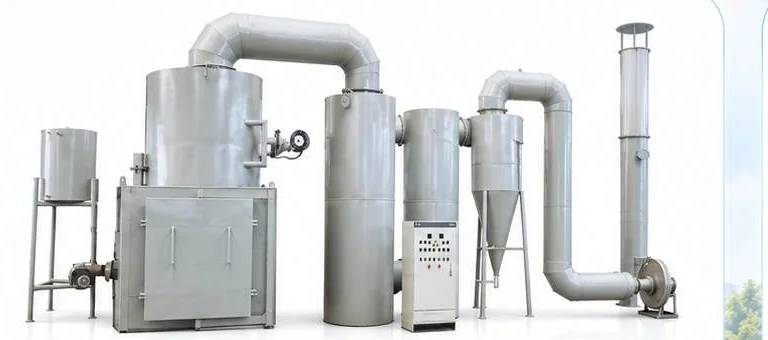
The first stage after the chamber is rapid cooling. The wet configuration here passes the gas into a quench cooling tower, which drops the temperature quickly rather than letting the gas drift down slowly through the range where re-formation is favoured. The deacidification tower that follows neutralises the acid gases — hydrogen chloride and sulphur dioxide among them — that would otherwise carry through to the stack.
The next stage is adsorption. An activated carbon adsorber captures the remaining dioxins, furans and heavy metals on the carbon surface, which is the stage in the train specifically directed at the compounds the temperature and time could not remove entirely. A bag dust collector then removes the particulate that carries the metals and any residual carbon, and the induced draft fan moves the cleaned gas to the stack. In the dry configuration the same duty is carried by Ca(OH)₂ filter bricks after secondary combustion, which neutralise acid gases and adsorb pollutants where the local limit is met by dry scrubbing.
Every stage in that chain answers a specific failure mode, which is the reason the emission limits are written as a set rather than as a single stack number. The chart of emission limits shows the pattern: for medical and hazardous waste, particulates at 30 mg/m³ as a one-hour mean, carbon monoxide at 100 mg/m³, and dioxins and furans at 0.5 ng TEQ/m³ as a measurement mean, with the municipal limits set at 0.1 ng TEQ/m³ for dioxins and furans and the same particulate figure. The dioxin limit is the number that the whole 850 °C, two-second and carbon-adsorption train exists to meet.
Reading the figures as one specification
- Secondary chamber at or above 850 °C, with the hazardous-waste indicator at or above 1,100 °C.
- Flue-gas residence time of at least 2.0 seconds in the hot zone.
- Excess oxygen and mixing, so the temperature and the time act on the whole gas stream.
- Rapid quench cooling after the chamber, to shorten the window in which re-formation can occur.
- Acid-gas neutralisation, activated carbon adsorption and particulate removal before the stack.
- Emission limits read as a set against the standard that applies to the site.
Read that way, 850 °C and two seconds are the front half of a dioxin control strategy, and the gas train is the back half. A specification that quotes the first without the second describes half a system.