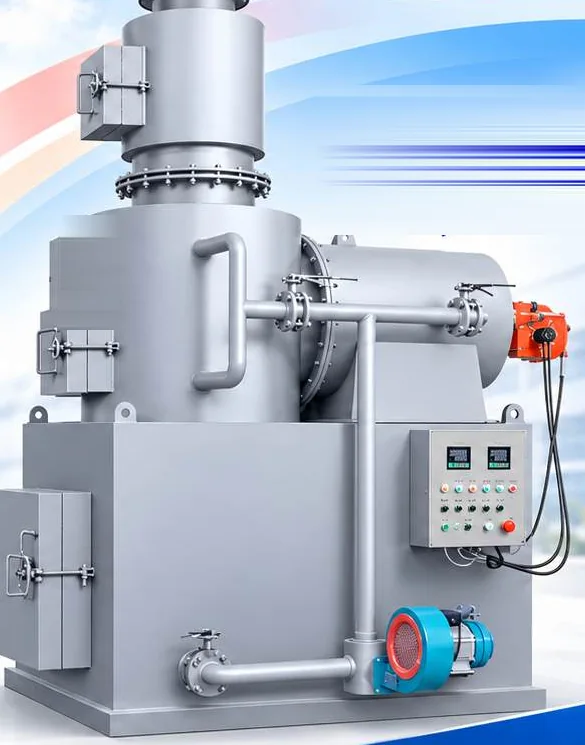
What a furnace has to do before the waste burns
Combustion in a bed of waste happens in three overlapping steps. The water leaves first, then the volatile matter comes off as gas, and then the fixed carbon that is left burns out. Every furnace type arranges those three steps somewhere in space and time, and the arrangement is what decides which feeds the furnace can accept. A rotary kiln incinerator does the three steps as its drum turns the load over on itself and walks it downhill; a grate furnace does them in sequence along the length of the grate as the waste is carried forward; a pyrolysis or gasification unit separates the second and third steps deliberately, driving the volatiles off with little or no oxygen and burning them afterwards.
Setting out the equipment range is a different job, and it is done on the incinerator pages, where the purification configurations and the individual units are described. This article stays on the waste side of the question, because the waste is what rules a furnace type in or out.
Rotary kiln incinerator for hazardous waste: the furnace that turns the feed over
A rotary kiln is a refractory-lined steel cylinder, slightly inclined and turning slowly, charged at the upper end and discharging at the lower. The load tumbles as the drum turns, so fresh surface is exposed to the flame and to the hot gas continuously, and material that would sit in a heap on a grate — a sealed drum, a bale, a stiff paste — is broken up by the movement itself. The kiln is the primary chamber; the gas it releases passes into a secondary chamber that completes the burn, and it is the second chamber that carries the temperature and the residence time the emission standard is written around.
The feed this suits is irregular. Hazardous and industrial waste is the classic duty: it arrives in drums, in sacks, as sludges and as liquids, it changes composition with every consignment, and none of it can be spread into an even bed. GB 18484-2020 sets the high-temperature section for hazardous-waste incineration at 1,100 °C with at least 2.0 seconds of residence time, and a refractory-lined kiln is the arrangement that holds a temperature like that while taking that kind of feed.
What the kiln costs is mechanical. There is a rotating shell with a seal at each end where it meets the stationary sections, and those seals are the maintenance item that defines the kiln’s reliability. The drum is charged in batches rather than fed in a thin continuous layer, so throughput is a property of the charging cycle as much as of the drum size. Heat loss and the mass of refractory to be heated and cooled are both larger than in a compact unit, which is why a kiln is usually the answer to a difficult feed rather than to a simple one.
Grate incinerator for municipal solid waste: the furnace that carries the feed through
A grate incinerator burns the waste on a moving bed. Rows of grate bars move in a reciprocating or forward sequence, so the refuse is pushed along the grate while combustion air is supplied both under the bars and over the bed. The waste dries at the feed end, ignites and burns through the middle, and the residue leaves as slag at the far end. That progression is why the grate is the furnace that turns a large, continuous, poorly sorted refuse stream into a steady process.
The steady process depends on a feed the grate can spread. A grate incinerator for municipal solid waste relies on the bed being reasonably even along the grate, and the classic design responses — mechanical pre-treatment, a mixing bunker, a feed ram that delivers a consistent layer — exist to protect that assumption. GB 18485-2014 sets the furnace temperature for municipal solid waste incineration at at least 850 °C with a residence time of at least 2 seconds and a slag ignition loss of no more than 5%, and the grate is the part of the plant that has to deliver that burn-out.
What the grate cannot do is accept a feed that will not lie down. A sealed drum of solvent, a sticky dewatered sludge or a bulky item that bridges the feed chute defeats the mechanism rather than merely slowing it, and a grate plant built for household refuse is usually protected from those streams by an acceptance rule at the gate rather than by the furnace.
Pyrolysis incinerator for solid waste: the furnace that splits the process in two
A pyrolysis unit heats the waste with no oxygen at all; a gasification unit admits a controlled fraction of the air the waste would need to burn completely. In both, the volatile matter is driven off as a combustible gas and a char is left behind, and the gas is burned in a second stage — which means a pyrolysis incinerator for solid waste still ends in a combustion chamber and still has a gas train behind it.
The engineering reason to do it is the volume of gas that has to be cleaned. In a conventional furnace most of the flue gas is nitrogen from the air supplied in excess, so a plant burning a tonne of waste produces a large volume of gas at a dilute pollutant concentration. A two-stage process supplies only as much air as the second stage needs, so the gas leaving the oxidation stage is smaller in volume and more concentrated. That is the argument for the arrangement on small decentralised plants, where the size of the gas train is a large part of the cost.
The cost is control. A pyrolysis stage has to be held in its own temperature band while the feed load moves, the char has to be handled, and a process with two reaction zones asks more of the operator than one with a single burning bed. Pyrolysis and gasification also sit differently from incineration in the regulations of most jurisdictions, so the residue and the emission duties of such a plant have to be confirmed against the rule that applies to the site rather than assumed from an incinerator’s.
Choosing an incinerator type by waste
Read as a starting point rather than as a specification, the common pairings fall out of the feed rather than out of the equipment catalogue.
- An incinerator type for medical waste from hospitals and clinics, which arrives in sacks and boxes on a daily cycle — a two-chamber unit in the small and medium sizes, where the duty is on-site destruction and infection control rather than tonnage.
- Municipal and domestic solid waste at a central plant — a grate furnace, because the feed is bulk, continuous and only partly sorted, and it can be spread and agitated along the grate.
- A uniform, high-calorific-value stream such as plastics, tyres or a single industrial residue — pyrolysis or gasification, because a two-stage process needs a feed that does not change from hour to hour.
- Dewatered sewage sludge, which carries more water than fuel — a dedicated unit with support fuel, or co-incineration with a drier stream, because sludge on its own will not hold a combustion temperature unaided.
- Hazardous and industrial waste that arrives drummed, packaged or as a sludge or paste, and any stream that changes with every delivery — the kiln, because the tumbling drum breaks up the feed and the refractory holds 1,100 °C.
What decides between them on a given site
Five conditions do most of the work, and the first two usually settle the question before the others are discussed.
- The form the waste arrives in — bulk and spreadable, or containerised, pasty and irregular.
- How much the feed varies. A furnace that depends on an even bed needs a feed that can be made even; a kiln tolerates variation that a grate cannot.
- The temperature the standard requires. Hazardous waste is held at a higher high-temperature-section figure than municipal waste, and that figure decides how much refractory and how much chamber volume the plant carries.
- Batch or continuous operation, and the residue route. Slag, ash and char are different materials with different disposal rules, and a site that cannot place one of them is choosing a different furnace.
Common mistakes
- Choosing the furnace type on purchase price and discovering afterwards that the feed cannot be handled. The furnace is the one part of the plant that cannot be adapted later.
- Assuming a pyrolysis unit removes the need for a flue-gas train. The gas still has to be burned and cleaned, and the emission limits apply to the plant as a whole.
- Putting a wet, sticky or bulky feed onto a grate and expecting pre-treatment to solve it. Pre-treatment makes a marginal feed manageable; it does not make an unspreadable feed spreadable.
- Sizing the furnace by tonnage alone, without the calorific value of the feed. The same kilograms per hour of two different wastes are not the same thermal duty.
- Reading a furnace type as a brand. A rotary kiln from two suppliers is the same furnace type, and the difference between suppliers sits in the seals, the refractory and the gas train.
Self-check before the furnace type is fixed
- Is the waste described by physical form and by variability, not only by tonnage and by name?
- Has the temperature the applicable standard requires been identified, along with the residence time that goes with it?
- Is the feed the plant will really receive — including the consignments that arrive without notice — the feed the furnace type was chosen against?
- Have the residue route and the heat content of the feed both been checked, so that the furnace is sized on thermal duty and the ash has somewhere to go?
- Is the gas train that follows the chamber included in the comparison between the three types?
From a waste stream to a furnace type
The pairing of waste and furnace type is settled before the equipment list is written, and it is settled from the feed: its physical form, how much it varies, and what has to happen to the gas and the residue afterwards. The incinerator pages carry the unit range and the purification configurations that follow each furnace type, the chart of incinerator emissions sets out the figures the plant has to meet, and the article on waste calorific value and the furnace takes the next question, which is how much heat the feed carries into the chamber. Send us the waste description and the standard that applies, and the furnace type, chamber size and gas train for your waste are confirmed with the factory for your waste composition rather than inferred from a general table.