Why sludge thickening before dewatering pays for itself
A sludge line carries two things at once: the solids the plant has to dispose of, and the water those solids are suspended in. Only the solids are the product of treatment. Everything else is ballast, and it is paid for several times over — in the size of the dewatering unit, in the polymer dose, in the volume the tanker carries and in the gate fee at the site that receives the cake.
The arithmetic is blunt enough to do on the back of an envelope. A tonne of sludge at 1 % dry solids holds about 10 kg of solids and about 990 kg of water. Concentrate that same 10 kg to 5 % and the material to be moved is about 200 kg. Nothing has been destroyed and nothing treated; the stream has simply become five times more concentrated and roughly a fifth of the mass. Sludge thickening is the stage that does it, and it is the cheapest place in the sludge line to do it, because the water leaves by settling or by flotation rather than under pressure.
The concentrations above are the ones usually quoted for municipal sludge and are given to show the size of the effect; they should be read as a starting method rather than as a specification, because what a plant holds is measured on its own sludge. Dewatering equipment is bought and driven on a solids duty — kilogrammes of dry solids per hour — while what it is fed is a volume, and that volume sets the size of the machine, the polymer demand and the filtrate load.
Where wastewater sludge thickening sits in the plant
Thickening is a stage, not a process. It sits between the clarifiers that produce the sludge and the dewatering unit that turns it into cake, and it usually has a holding tank on one side of it, so that the dewatering unit can run to its own schedule rather than at the pace the clarifiers produce sludge.
Two sludges arrive and they behave nothing alike. Primary sludge, drawn from the bottom of a primary clarifier, is mineral-heavy and granular, and settles and compacts readily. Waste activated sludge, drawn as surplus biomass from the secondary clarifier, is light, hydrated and gelatinous: it holds water in and between the flocs and compacts poorly under its own weight. Wastewater sludge thickening therefore has to be chosen per stream, because a tank that works on primary sludge will often produce a thin underflow and a dirty overflow on biological sludge. The two streams may be thickened separately, the usual answer on a larger plant, or combined where primary solids dominate.
One consequence is easy to leave out of a design and expensive to discover later. Whatever the stage takes out as water comes back to the plant as supernatant or filtrate, and it is not clean water: it carries fine solids that escaped capture, ammonia released from the sludge, and phosphorus. That side stream re-enters the head of the works and is part of the load the biological stage sees. On a plant with a large sludge line it can be a material fraction of the nitrogen load, and a design that counts only the raw influent will be short of capacity.
Gravity thickening of sludge
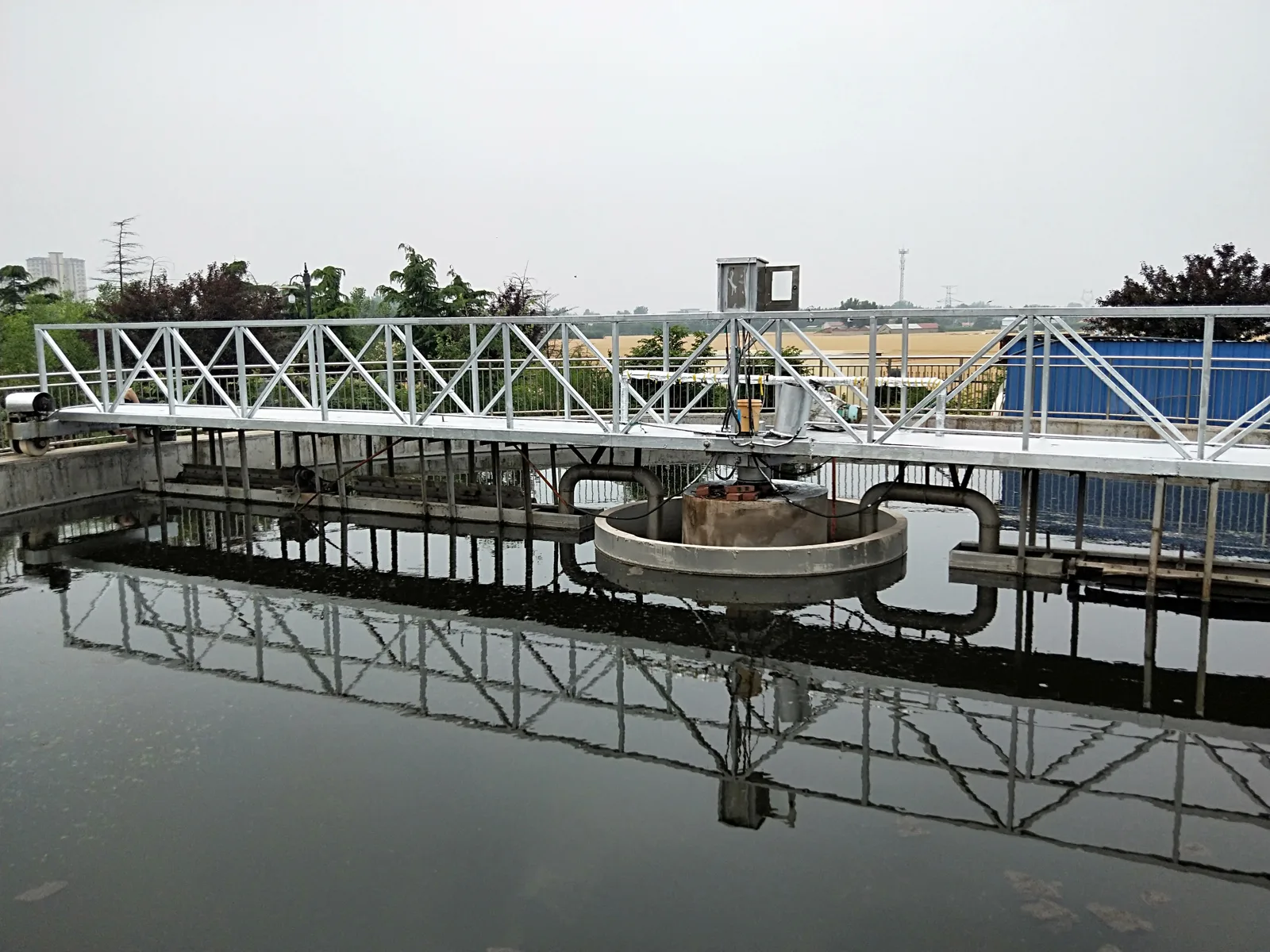
A gravity sludge thickener is a tank with a slow-moving scraper mechanism. Sludge is fed near the centre, the solids settle, a set of vertical picket arms stirs the blanket and lets trapped water escape upwards, thickened sludge is drawn from the bottom cone, and the released water overflows a weir at the rim. No chemical is involved and almost no power: the mechanism turns at a rate measured in metres per hour at the rim.
Its virtues are running cost and simplicity, and its limit is the sludge it is asked to handle. On primary sludge it produces a well-compacted underflow from a large flow, which is why it remains the first choice where primary sludge exists. On waste activated sludge the flocs do not settle into a compact blanket, so the unit needs a much larger area for the same solids load, the underflow is weaker, and the overflow carries more solids back to the head of the plant. Filamentous bulking makes it worse: the filaments that stop the sludge settling in the clarifier stop it thickening here.
Sizing rests on two figures rather than on a table: the solids loading per unit of surface area, and the hydraulic overflow rate. Both come from settling tests on the actual sludge — a batch settling test read against a stirred version that accounts for the action of the mechanism. A gravity thickener is also a large open tank of concentrated solids, so odour and septicity are design questions, and a cover may be needed in a populated area.
Dissolved air flotation sludge thickening
Dissolved air flotation sludge thickening works on the opposite principle to settling. A fraction of the clarified effluent is recycled, pressurised and saturated with air, then released into the contact zone of the tank. The pressure drop makes the dissolved air come out as a cloud of micro-bubbles, which attach to the flocs and lift them to the surface, where the floated blanket is held and skimmed off. The solids rise rather than fall, so the unit does not depend on the sludge settling at all.
That is why flotation is the usual answer for waste activated sludge, and for mixed sludge where biological solids dominate. It produces a thicker float than a gravity thickener manages on the same material, captures solids more completely into that float rather than into the return liquor, and can be built in a shallow tank, so the footprint is smaller than the settling area the same duty would need.
The price is equipment and chemical. A flotation thickener carries a saturator vessel, a recycle pump, an air compressor and a skimming mechanism, and it needs polymer conditioning — usually a cationic grade — to bind the flocs into something the bubbles can lift. The dose is set by bench flotation or jar testing on the sludge in hand rather than by a table. The air-to-solids ratio, the recycle ratio and the surface loading rate are the design variables, and their values for a given sludge come from that testing.
Rotary drum sludge thickener and gravity belt thickening
A rotary drum sludge thickener does mechanically what a thickener tank does by area. The sludge is conditioned with polymer and fed into a slowly rotating drum lined with a fine mesh. Water drains through the mesh while a scroll inside conveys the thickened sludge along and out, and the mesh is sprayed clean on every revolution so that it does not blind over. A gravity belt thickener is the same duty on a moving belt instead of a drum.
Both are compact, enclosed and low in energy, they reach working condition in minutes rather than hours, and they tolerate starting and stopping without losing their contents, which is why they suit a packaged plant or a duty that runs to a shift pattern. Both consume polymer, so the conditioning step matters as much as the machine.
There is also a route that removes the separate stage. Where the sludge line ends in a screw press that thickens and dewaters in one continuous machine, the thickening zone of that machine does the work a separate thickener would do, and a plant below a certain size is usually simpler without a standalone stage.
Which thickening route fits the plant
- Primary sludge, land available, running cost the priority — a gravity sludge thickener, no chemical and no more power than the scraper drive.
- Waste activated sludge, or mixed sludge dominated by biological solids — dissolved air flotation sludge thickening, because flotation does not ask the sludge to settle.
- Limited footprint, or a plant inside a building — rotary drum or gravity belt thickening, both compact and enclosed.
- Sludge held between shifts, or a dewatering unit run to a schedule — a holding tank sized on daily solids production, not on instantaneous sludge flow.
- A small plant already buying a screw press that thickens and dewaters — no separate stage, provided the machine is fed at the consistency it was sized on.
- A site where odour is a live constraint — enclosed mechanical thickening rather than an open gravity tank.
Common mistakes
- Treating thickening as an optional extra. Every tonne of water removed before the dewatering unit is a tonne that does not have to be pressed, dosed, pumped or hauled.
- Assuming gravity thickening will work on waste activated sludge. It is the commonest wrong assumption in the sludge line, and it shows up as a weak underflow and a solids load returning to the head of the works.
- Designing the thickening stage and the dewatering unit separately. The cake the press produces, and the polymer it needs, depend on the consistency of what it is fed.
- Setting a polymer dose from a table. Dose follows the sludge, and the sludge changes with the season, the load and the state of the biomass.
- Shearing the floc between two stages. A floc that has been built is easily broken by a pump running too fast, and broken floc re-suspends solids in the water the stage was there to remove.
Self-check before the thickening stage is specified
- Has the sludge been identified and tested as primary, biological or mixed, rather than assumed from the plant type?
- Is the daily solids production known, so that the duty can be stated in kilogrammes of dry solids per day?
- Is the solids concentration of the feed, and the target concentration after thickening, both stated?
- Has the return liquor from the stage been counted in the load the biological process has to treat?
- Does the thickened sludge reach the dewatering unit without being sheared or diluted on the way?
From a thickening duty to a machine
The choice above narrows the route; the machine still has to be sized on a sludge that has been measured. The sludge dewatering equipment pages describe what each dewatering machine does with the thickened feed, and the guide to selecting sludge dewatering equipment takes the sludge type, the volume and the target cake and works through the options in order. Where the duty is to be met by flotation, the dissolved air flotation pages cover the mechanism and the tank arrangements it is built in. The model, the surface area and the polymer consumption that suit your sludge are confirmed with the factory for your sludge type and your target concentration rather than read off a table.