Selecting a plant for food and beverage processing wastewater.
Process wastewater from food and beverage lines is stronger and more variable than domestic sewage. The plant is sized on the waste stream first, then on the flow.
Which processors
Dairy
milk, cheese and yoghurt lines with a high organic load and heavy cleaning water.
Meat and slaughterhouse
high-strength wastewater carrying blood, solids and grease.
Beverage
brewing, bottling and juice plants with variable flow and wash-down water.
Fruit and vegetable
washing and peeling water carrying soil and organic solids.
Bakery
process and cleaning wastewater with fats and suspended solids.
Seafood
processing water that can carry salinity as well as organic load.
What makes this wastewater different
The character of the waste stream, rather than its volume, is what usually decides the process train.
- High organic load — process water carries far more organic matter than domestic sewage of the same volume.
- Fats, oils and grease (FOG) — grease from cooking and cleaning coats equipment and has to be removed early.
- High suspended solids — solids from product handling and washing load the front of the plant.
- Variable and batch flow — discharge follows the production schedule, not a steady daily pattern.
- pH swings — cleaning chemicals can push the waste stream acidic or alkaline within a single shift.
- Possible salinity — seafood and brine processing can add salt that affects the biology.
Pre-treatment first
Fat, solids and grease are removed before the biology, because the biological stage is sized on what reaches it.
- 1Screening — remove coarse solids and debris before they reach the process.
- 2Grease removal — separate fats, oils and grease so they do not load the biological stage.
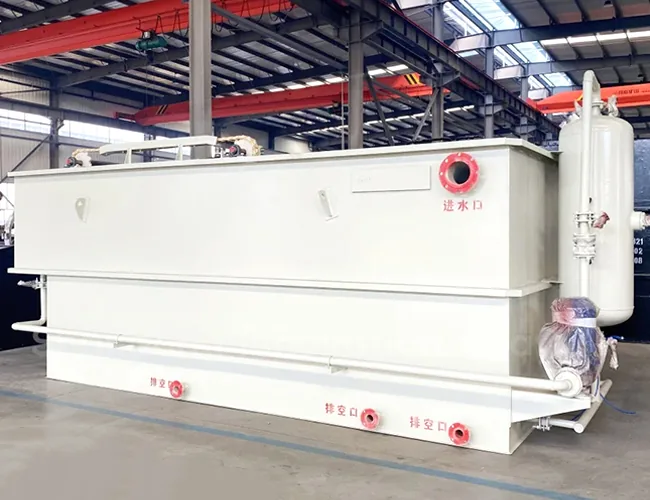
- 3Dissolved air flotation (DAF) — lift fine solids and remaining grease to the surface for removal.
- 4Biological treatment — A/O or MBBR for organic and nitrogen removal, or MBR where a compact footprint and a higher effluent quality are needed.
Selection steps
- 1Characterize the waste stream — flow pattern, organic load, grease, solids and pH come first.
- 2Size pre-treatment and the biology — equalization, grease removal and DAF where needed, then the biological stage.
- 3Set the discharge or reuse target — the required standard and any reuse intent decide the final treatment step.
What to send us
- Design flow (m³/day) and the flow pattern.
- COD, BOD₅, FOG, TSS, pH and temperature.
- Seasonality — how production, and therefore discharge, changes through the year.
- Discharge standard.
- Reuse intent — irrigation, landscaping or process water.
Reuse option
Where reuse is the objective, the plant can be configured to produce water suitable for a non-potable duty. The reuse target is fixed during sizing, together with the treatment step needed to reach it.
Irrigation
water for on-site or nearby irrigation where reuse is permitted.
Landscaping
water for grounds and green areas around the plant.
Process water
water returned to selected non-potable duties inside the plant.