Incinerator emissions and process parameters.
The combustion parameters an incinerator is specified on, and the flue-gas emission limits the national standards set for medical, hazardous and municipal solid waste.
Basis
Flue-gas emission limits are national standard table values. GB 18484-2020 Table 3 gives the limits for hazardous-waste incineration; GB 39707-2020 Table 4 gives the limits for dedicated medical-waste incineration, which GB 18484-2020 §1 excludes from its scope; GB 18485-2014 Table 4 gives the limits for municipal solid waste incineration. The combustion and process parameters in the first table are vendor-published figures from the maker product pages (xjyincinerator.com) and are not national standard values. The incinerator technical performance indicators from GB 18484-2020 Table 1, GB 39707-2020 Table 1 and GB 18485-2014 Table 1 are listed in the notes for comparison.
Combustion and process parameters
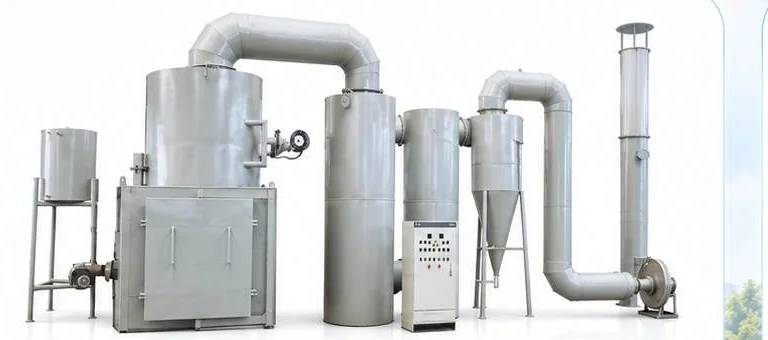
These are the figures the equipment maker publishes for its incinerator range, on a hospital clinical waste basis. They are vendor-published figures, not national standard values.
| Parameter | Published value | Source | Evidence level |
|---|---|---|---|
| Incineration temperature | ≥850 °C | xjyincinerator.com product pages | Vendor-published figure |
| Flue-gas residence time | ≥2.0 s | xjyincinerator.com product pages | Vendor-published figure |
| Incineration efficiency | ≥99 % | xjyincinerator.com product pages | Vendor-published figure |
| Residue loss on ignition | ≥5 % as published | xjyincinerator.com product pages | Vendor-published figure |
| Waste volume reduction | Up to 90 % by volume, the balance becoming ash and flue gas | xjyincinerator.com product pages | Vendor-published figure |
| Combustion temperature range, process description | 800–1,200 °C | xjyincinerator.com product pages | Vendor-published figure |
The maker publishes an incineration efficiency of ≥99 %; this is not the destruction and removal efficiency (DRE) defined in GB 18484-2020. The residue loss on ignition is published as ≥5 %, which reads the other way round from the national standard that sets it below 5 %: [to be confirmed with factory].
Flue-gas emission limits: medical and hazardous waste versus municipal solid waste
| Parameter | Medical and hazardous waste | Municipal solid waste |
|---|---|---|
| Particulates | 30 (1 h mean) / 20 (24 h mean) | 30 (1 h mean) / 20 (24 h mean) |
| CO | 100 (1 h mean) / 80 (24 h mean) | 100 (1 h mean) / 80 (24 h mean) |
| NOx | 300 (1 h mean) / 250 (24 h mean) | 300 (1 h mean) / 250 (24 h mean) |
| SO2 | 100 (1 h mean) / 80 (24 h mean) | 100 (1 h mean) / 80 (24 h mean) |
| HCl | 60 (1 h mean) / 50 (24 h mean) | 60 (1 h mean) / 50 (24 h mean) |
| HF | 4.0 (1 h mean) / 2.0 (24 h mean) | Not listed |
| Mercury (Hg) | 0.05 (measurement mean) | 0.05 (measurement mean) |
| Cadmium and thallium (Cd + Tl) | Cadmium 0.05 and thallium 0.05, listed separately (measurement mean) | 0.1 combined (measurement mean) |
| Other metals | Lead 0.5; arsenic 0.5; chromium 0.5; tin + antimony + copper + manganese + nickel + cobalt 2.0 (measurement mean) | Antimony + arsenic + lead + chromium + cobalt + copper + manganese + nickel 1.0 (measurement mean) |
| Dioxins and furans (ng TEQ/m³) | 0.5 (measurement mean) | 0.1 (measurement mean) |
All values are mg/m³ unless stated, referenced to 11 % O2 in dry flue gas at standard conditions. The 1 h and 24 h figures are alternative averaging periods for the same parameter, not separate parameters. HF and the metals grouping are not identical between the two standards; cells marked Not listed are not given by that standard. For hazardous-waste incineration the limits are in GB 18484-2020 Table 3; for dedicated medical-waste incineration they are the same numeric values in GB 39707-2020 Table 4; for municipal solid waste they are in GB 18485-2014 Table 4.
How to use and notes
- The combustion parameters in the first table are the maker published figures and carry vendor-published status only. They are not national standard values and must not be presented as such.
- Destruction and removal efficiency is a national standard indicator, not a vendor figure. GB 18484-2020 Table 1 sets the hazardous-waste incinerator indicators as high-temperature-section temperature ≥1100 °C, flue-gas residence time ≥2.0 s, combustion efficiency ≥99.9 %, destruction and removal efficiency ≥99.99 % and heat ignition loss rate <5 %.
- GB 39707-2020 Table 1 sets the medical-waste incinerator indicators as high-temperature-section temperature ≥850 °C, flue-gas residence time ≥2.0 s and combustion efficiency ≥99.9 %.
- GB 18485-2014 Table 1 sets the municipal solid waste incinerator indicators as furnace temperature ≥850 °C, flue-gas residence time ≥2 s and slag heat ignition loss rate ≤5 %.
- GB 18484-2020 §1 excludes dedicated medical-waste incineration facilities from its scope; those facilities are covered by GB 39707-2020. The emission limits of the two standards are the same numeric values for every parameter shown here, and differ only in how the residual metals are grouped.
- The emission limits are national standard table values. A local provincial standard may be stricter than the national one, and a project may also be held to an environmental impact assessment limit; always check the permit that applies to the site.
- The maker publishes a residue loss on ignition of ≥5 %, which is inconsistent with the national standard of below 5 %: [to be confirmed with factory]. The applicable emission limits and test standard for a specific model are confirmed per project.