Small-scale incinerators for on-site waste disposal.
Compact incinerators that dispose of general and light medical waste on site where space or daily volume is limited, with high-temperature combustion and a flue-gas purification stage.
What it is
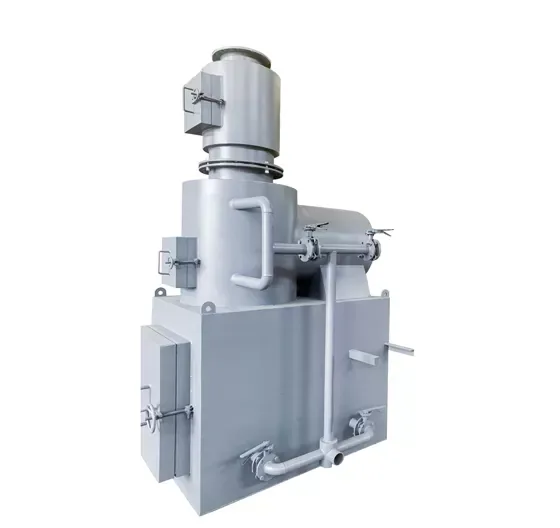
A small-scale incinerator disposes of waste on the site where it is produced, without the footprint or the site works of a larger plant. Waste is loaded into the primary combustion chamber, where it is dried and pyrolysed, and the gases pass into a secondary chamber held at or above 850 °C to complete the burn before the flue gas is cleaned and released. Combustion at these temperatures reduces the waste volume by up to 90 % and destroys pathogens, so the unit suits premises that generate a moderate amount of waste and have limited access to a central treatment facility — households, small businesses, farms, remote sites, smaller communities and clinics. The unit is space efficient and needs a simple foundation, and the design is deliberately simple so routine operation and maintenance stay within the reach of ordinary staff.
How it works
- 1Waste is fed into the primary combustion chamber through a loading chute or door.
- 2In the primary chamber the waste is dried, pyrolysed and partly combusted at a controlled temperature, releasing volatile gases while the residual ash stays behind.
- 3The combustible gases flow into the secondary chamber, where a higher temperature of at least 850 °C and excess oxygen complete the oxidation of harmful compounds.
- 4The flue gas passes through purification — quenching to neutralise acid gases and filtration to capture particulate and heavy metals — before it leaves through the chimney.
- 5The remaining ash and residue are collected for disposal.
The purification train is included with the unit, so no separate gas-treatment purchase is required. Residence time, quenching and filtration stages are matched to the waste being burned and the local emission limit.
Models and specifications
The configuration published for this range is the XJY-300. Smaller capacities are offered for low daily volumes; their dimensional, burner and weight data are [to be confirmed with factory].
| Item | XJY-300 |
|---|---|
| Incineration capacity | 300–400 kg/h |
| Unit dimensions (L × W × H) | 3 × 2 × 4.8 m |
| Waste feeding inlet | 1080 × 1280 mm |
| Chimney | OD φ460 mm |
| Induced draft fan | 1.1 kW |
| Auxiliary combustion burner (estimated) | Power 0.15 kW; fuel consumption 10–20 kg/h |
| Re-combustion burner (estimated) | Power 0.37 kW; fuel consumption 15–26 kg/h |
| Operating voltage | 380 V or 220 V |
| Approximate weight | 16,500 kg |
Applications
Households and small premises
Kitchen, paper and general household waste is reduced to ash instead of being accumulated for collection.
Small businesses
Offices, restaurants and retail premises with limited space dispose of their own general waste.
Remote locations
Rural and remote sites where access to a central waste facility is limited or unreliable.
Farms and agricultural sites
Farm and site waste is burned on the premises, away from buildings and flammable material.
Medical facilities
Some models are configured to dispose of light medical waste, subject to the local healthcare regulation.
Emissions and configuration
Small units of this kind operate between roughly 800 °C and 1,200 °C, which is what gives the volume reduction and the pathogen kill; the secondary chamber holds the upper part of that range to finish the burn. Emission control is part of the supplied unit: filters and scrubbers capture particulate and reduce harmful gases so the exhaust meets the standard that applies at the site. Some larger configurations can be fitted with heat recovery to use the combustion heat for hot water or power, and fuel can be diesel or gas where the waste is high in moisture or the load is intermittent. Because the load varies by day, the unit is sized on the daily waste volume rather than on a peak hour figure.
| Waste basis | Hospital clinical waste (published test basis) |
|---|---|
| Incineration temperature | ≥850 °C |
| Flue-gas residence time | ≥2.0 s |
| Incineration efficiency | ≥99 % |
| Residue loss on ignition | ≥5 % as published [to be confirmed with factory] |
| Operating voltage | 380 V or 220 V |
The published capacity of the documented XJY-300 configuration is high for the name of this range; confirm the unit that matches your daily volume when requesting a proposal. Emission limits and the applicable test standard are confirmed per project.