Municipal and domestic solid waste incinerators.
General solid waste incinerators for towns, communities, commercial complexes and industrial sites, from 50 to 500 kg/h, with a fully enclosed combustion design and dry, wet or basic flue-gas purification.
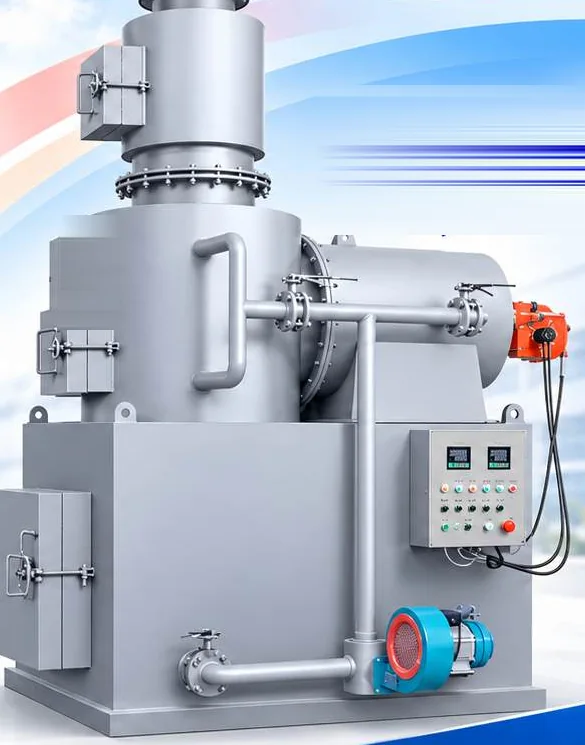
What it is
A municipal or domestic solid waste incinerator disposes of general household and commercial waste by controlled combustion, reducing its volume and its harmfulness before the residue is landfilled. Waste is fed into a fully enclosed primary chamber, where it is dried, pyrolysed and partly burned; the gases then pass into a secondary combustion chamber that completes the burn before the flue gas is cooled and cleaned. The XJY series is built as a compact, fully enclosed unit with a straightforward process flow, sized by the daily waste tonnage and by whether the waste is dry, mixed or high in moisture. Where a central treatment plant is not available, a unit of this kind is how a town, a market, a hospital complex or an industrial park handles its own waste on site.
How it works
- 1Waste is loaded into the enclosed primary chamber through the charging door, and the chamber is held under negative pressure so no gas escapes during loading.
- 2Primary combustion dries, pyrolyses and partly burns the waste at a controlled temperature, releasing volatile gases and leaving a residual ash.
- 3The gases pass into the secondary combustion chamber, held at or above 850 °C with excess oxygen and a flue-gas residence time of at least 2.0 seconds, completing the oxidation of harmful compounds.
- 4The flue gas is cooled and cleaned — dry purification with Ca(OH)₂ filter bricks, wet purification with quench and deacidification towers, activated carbon adsorption and bag filtration, or the basic single-train configuration.
- 5The cleaned gas leaves through the induced draft fan and the chimney, and the ash is discharged for disposal.
Fresh waste should be segregated before burning: non-recyclable dry waste such as paper, cardboard and untreated wood is suitable, while plastics, batteries and chemicals should not be fed to the unit. Combustion figures published for this range: incineration temperature ≥850 °C, flue-gas residence time ≥2.0 s, incineration efficiency ≥99 %.
Models and specifications
Published data for the XJY general solid waste series. Burner and weight data that the source does not publish are marked [to be confirmed with factory].
| Model | Incineration capacity | Unit dimensions (L × W × H) | Waste feeding inlet | Chimney | Induced draft fan | Approximate weight |
|---|---|---|---|---|---|---|
| XJY-50 | 50–100 kg/h | 1.8 × 1.15 × 3 m | 620 × 800 mm | OD φ280 mm | 0.37 kW | 5,000 kg |
| XJY-100 | 100–150 kg/h | 2 × 1.4 × 3.5 m | 760 × 960 mm | OD φ300 mm | 0.55 kW | 8,000 kg |
| XJY-200 | 200–300 kg/h | 2.2 × 1.4 × 3.8 m | 900 × 1100 mm | OD φ400 mm | 0.75 kW | 8,500 kg |
| XJY-300 | 300–400 kg/h | 3 × 2 × 4.8 m | 1080 × 1280 mm | OD φ460 mm | 1.1 kW | 16,500 kg |
| XJY-400 | 300–400 kg/h | 3 × 2 × 4.8 m | 1080 × 1280 mm | OD φ460 mm | 0.75 kW | [to be confirmed with factory] |
| XJY-500 | 400–500 kg/h | 3.3 × 2.3 × 4.8 m | 1080 × 1280 mm | OD φ480 mm | 1.1 kW | [to be confirmed with factory] |
Applications
Communities and towns
Domestic waste from a town, a village or a housing area that has no central treatment plant is reduced to inert ash on site.
Commercial complexes
Hotels, markets, transport hubs and large commercial buildings handle their own general waste without a collection contract.
Hospitals and institutions
General solid waste from hospital complexes, campuses and institutions is burned alongside their clinical waste stream.
Industrial parks and enterprises
General solid and non-recyclable waste from manufacturing tenants is disposed of inside the park boundary.
Farms and rural sites
Rural and agricultural sites with no reliable collection service use a unit sized to their daily waste.
Emissions and configuration
Three flue-gas configurations are offered on this range. Dry purification passes the gas through Ca(OH)₂ filter bricks after secondary combustion and is the standard choice where the local limit is met by dry scrubbing. Wet purification adds a multi-stage train — quench cooling tower, deacidification tower, activated carbon adsorber and bag dust collector, with a venturi scrubber and cyclone in the wet-type arrangement — for stricter limits. The basic configuration is a single compact combustion train without the wet stages, for general solid and hazardous waste where a simpler train is accepted. The configuration is chosen from the waste stream and the emission standard at the site.
| Waste basis | Hospital clinical waste (published test basis) |
|---|---|
| Incineration temperature | ≥850 °C |
| Flue-gas residence time | ≥2.0 s |
| Incineration efficiency | ≥99 % |
| Residue loss on ignition | ≥5 % as published [to be confirmed with factory] |
| Operating voltage | 380 V or 220 V |
Emission limits and the applicable test standard are confirmed per project. Manufacturers of the burner train publish auxiliary and re-combustion burner data per model; those figures are supplied with the commercial offer and are [to be confirmed with factory] where not listed above.