Start from the waste, not from a model
The first figure to establish is the mass of infectious waste the site produces on an average day — not the largest model the budget will reach. A capacity fixed before the daily figure is known is a guess, and both ways of guessing wrong cost money. A unit that is too small leaves waste waiting and forces longer burning cycles; a unit that is too large burns more fuel every month for no operational benefit.
The stream to count is the fraction that has to be destroyed on site: used syringes and sharps containers, contaminated gauze and dressings, disposable gloves, gowns and masks, and expired medicines and single-use supplies. The sharps and the pathology fraction are the parts that cannot go to ordinary disposal, and they are the reason the site needs a destruction route rather than a sterilisation one.
Put a number on the daily output
A facility that has never weighed its waste can start from the reference bands published for grassroots medical sites: a village health post or a small outpatient clinic at 15–30 kg per day, a community-level medium clinic at 30–50 kg per day, and a small private hospital of 10–30 inpatient beds at 50–100 kg per day.
Those bands are planning references, not measurements. Where records exist — the weight of the collection bags, or a count of sharps containers against their nominal fill mass — they should replace the band. The stronger the record, the less allowance has to be carried later.
Add a margin, and make it an explicit one
Infectious waste is not steady. Patient numbers rise in a flu season or a local outbreak, and the unit has to take the spike without stockpiling. The published guidance is to add 20–30% to the present daily volume before the model is chosen. The margin is a decision, so it should be stated with its reason: a facility with a strong seasonal swing sits at the upper end, and one with a flat load can sit lower.
From daily output to an hourly rating
Incinerator capacity is published as a mass per hour, not per day, so the daily figure has to be divided by the hours the unit will actually run. Most small clinics operate the unit for 1–3 hours after it closes, and that operating window is the second input to the calculation. A unit rated at 100 kg per hour covers a very different daily duty when it runs for one hour and when it runs for three.
The direction of the check matters: divide the design daily mass by the available hours, and compare the result with the published hourly rating. If the answer sits at the top of a model range, the next model up is usually the safer choice, because the rating is published for a defined waste basis rather than for the worst waste the site will see.
What the published ratings assume
Every published capacity figure in this range is stated on a hospital clinical waste basis, and that basis is what the number means. Throughput is not fixed by the furnace alone. It falls when the waste is wet, because fluid-soaked dressings evaporate before they burn, and it falls again when the stream carries little combustible material. A unit sized against a dry, mixed waste record will not reach the same rate on a wet one.
This is why the guidance is to move up a size where a facility produces a large share of wet waste, rather than to accept the top of the range as the working figure. The rating is a test-basis figure, and the site has to decide how far its own waste differs from that basis.
Match the figure to a published model
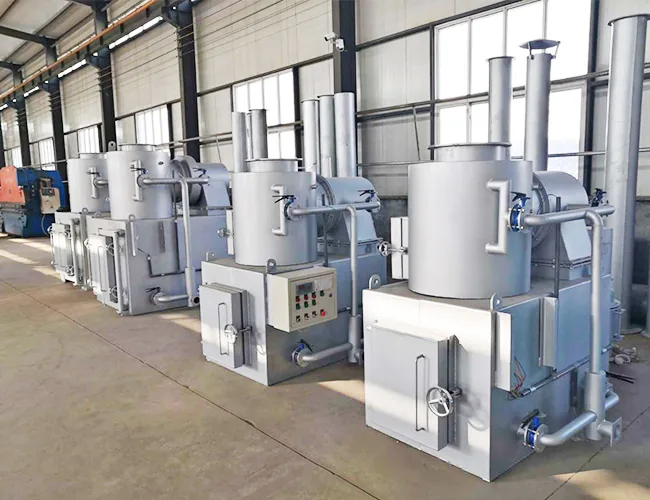
The ranges here are published in steps, so the calculation usually lands between two of them. In the compact medical range, the XJY-100 is published at 100–150 kg per hour in a unit measuring 2 × 1.4 × 3.5 m and weighing about 8,000 kg; the smaller XJY-30 and XJY-50 units cover lower daily outputs, and the larger LDF range runs from the LDF-20 batch unit to the LDF-200.
Where the duty is higher — a hospital group, a regional facility or a mixed medical and general waste stream — the basic range steps up through the XJY-200 at 200–300 kg per hour and the XJY-300 at 300–400 kg per hour, to the XJY-500 at 400–500 kg per hour. The municipal and solid waste range is published from 50 to 500 kg per hour over the same model series.
Two figures travel with every model and belong in the same comparison. The first is the footprint: the XJY-500 measures 3.3 × 2.3 × 4.8 m and the XJY-300 measures 3 × 2 × 4.8 m, so the space at the site and the loading arrangement have to be checked as soon as the model is shortlisted. The second is the gas train, because the model alone does not fix the emission configuration; dry purification, wet purification and the basic train are separate choices made against the waste and the local limit.
The checks that decide the final choice
- Daily infectious waste mass, from records where they exist and from the published reference bands where they do not.
- Seasonal margin of 20–30%, stated as a decision rather than hidden in the model choice.
- Operating hours per day, because the published rating is per hour and the duty is per day.
- Waste character: wet or low-combustible streams push the selection up a size.
- Footprint, weight and loading arrangement for the shortlisted model.
- Emission configuration, decided against the local limit rather than by the model alone.
The same sequence appears in the emissions and process parameters chart, which lists the combustion figures every model is held to — an incineration temperature of at least 850 °C, a flue-gas residence time of at least 2.0 seconds and a published incineration efficiency of at least 99%. Those figures are what the sizing is protecting; they are the reason the hourly rating has to be met on the site waste and not only on paper.