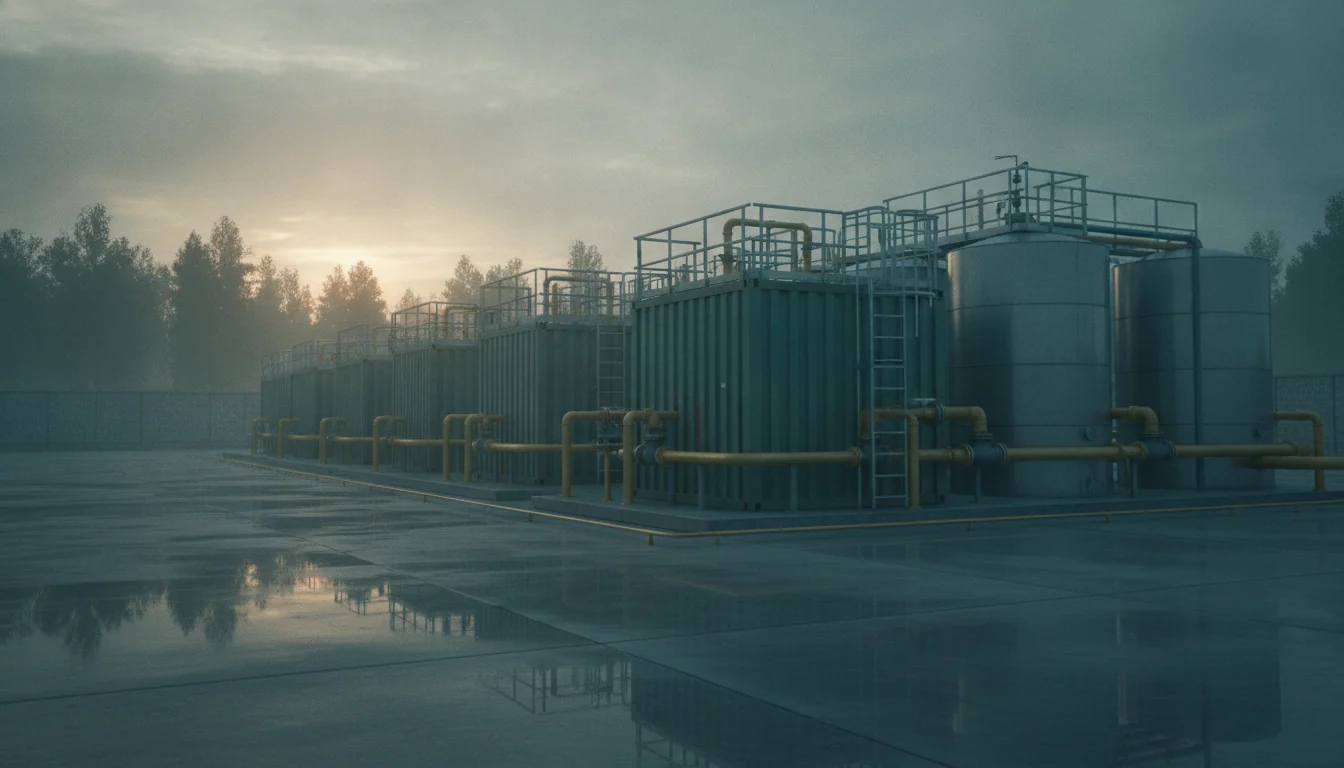
Source water decides the train, not the region
A water treatment process is chosen from the water it will receive, and that water is a set of measurements rather than a place. Buyers often open with the country or city a plant is going to and expect a package to follow from it. The country tells you the supply, the permit and the delivery route; it does not tell you the process. Two wells a kilometre apart can hold water at the same temperature with different concentrations of fluoride, and one river can be soft and clear at the end of the dry season and salty a month later.
The spread inside one country is usually wider than the spread between two. A plant on the coast and one on a highland plateau in the same country may need different trains, while two plants on one aquifer on opposite sides of a border may need the same one. Selection starts from a raw-water analysis, and the analysis is what an enquiry should carry rather than a country name.
The five parameters that change the design
Most of the difference between two trains is carried by five parameters, and reading an analysis for these five is a faster route to a process than reading a catalogue. Surface water vs groundwater is a useful first cut — surface water carries solids and a light dissolved load, groundwater usually arrives clear and carries its problem in solution — but all five parameters below cross it.
- Total dissolved solids and salinity. Below about 1,000 mg/L the water is fresh and the train is filtration and disinfection. From roughly 1,000 to 10,000 mg/L it is brackish, and that is the band where brackish water reverse osmosis is usually considered, at a running pressure commonly described as roughly 7 to 25 bar. These boundaries are engineering convention rather than a standard, and should be read as a starting method rather than a specification.
- Hardness. Calcium and magnesium scale the inside of pipes, heat exchangers and membranes. The step it adds is softening — lime and soda ash, or ion exchange — and where a membrane follows, hardness decides whether it is protected or damaged.
- Iron and manganese. Above the secondary values of 0.3 mg/L for iron and 0.05 mg/L for manganese (US EPA secondary drinking water standards) the water stains and tastes metallic, and iron removal from water at that level is an oxidation step — aeration or chlorination — followed by filtration, not a membrane step.
- Fluoride and arsenic. Both are dissolved and both are regional, so neither can be assumed present or assumed absent. Fluoride removal from water is usually adsorption on a dedicated medium, or a membrane step where the concentration is high; arsenic is removed by oxidation with coagulation, by adsorption, by ion exchange or by a membrane.
- Turbidity and its season. This is the parameter that moves most, and it moves with the calendar. The WHO review of turbidity puts the target for conventionally filtered water at no more than 0.3 NTU for at least 95% of the time and never above 1 NTU, with water entering disinfection below 1 NTU.
Surface water: high turbidity, low mineral load — what a package plant covers
A drinking water treatment process built for a river or a lake is a solids-removal process, and the conventional train is well established: coagulation to destabilise the particles, flocculation to grow them into flocs that settle, sedimentation to let them settle, filtration to catch what did not, and disinfection to finish. Because the dissolved load is usually light, a surface-water train can stay simple.
That train is what an integrated water purifier packages. Dosing, flocculation, sedimentation and filtration sit together on one skid, which suits low-TDS, high-turbidity surface water: the work is mechanical and hydraulic rather than membrane-based, so it is simple to install and to run.
The complication on surface water is the season, not the average. Turbidity arrives in events — a first rain after a dry spell, a construction season upstream, an algal bloom — and a plant sized on an annual mean is short on exactly the days that matter. A higher design turbidity than the mean absorbs part of it, and storage or equalisation ahead of the plant absorbs the rest.
Groundwater: oxidation, softening, adsorption, and when RO earns its place
Groundwater usually arrives clear, cool and free of the solids that dominate surface-water design, and its load is in solution. There is little to settle, so the steps are chemical and adsorptive rather than physical, and the analysis of dissolved parameters is what the design is built on.
Iron, manganese and hardness are the ordinary cases. Oxidation followed by filtration takes iron and manganese out where they sit above the secondary values, and softening takes out hardness by lime and soda ash or by ion exchange. Neither needs a membrane, and putting one in front of un-oxidised iron is a common way to foul a membrane that was never necessary.
Fluoride and arsenic are the cases that make groundwater interesting, and both are regional in a way a region alone does not describe. In the East African Rift the dominant problem is fluoride rather than salt: in the Ethiopian main rift, 31% of deep wells and 38% of shallow wells exceed the WHO guideline of 1.5 mg/L, and springs on Mount Meru in Tanzania have been reported at 15 to 63 mg/L. In Bangladesh the problem is arsenic: 50 districts exceed the national standard of 50 µg/L and 59 exceed the WHO value of 10 µg/L. The routes differ accordingly — adsorption for fluoride; for arsenic, oxidation with coagulation, adsorption, ion exchange or a membrane.
Reverse osmosis earns its place when the dissolved load is high enough to make the other steps uneconomic, which in practice means entering the brackish band. The order matters: iron, manganese, hardness and turbidity come out ahead of the membrane, because it removes dissolved salt rather than solids, and anything that can precipitate will do so on its surface.
When "Africa = RO" is wrong, and when "Asia = package plant" is wrong
Two regional defaults circulate in export conversations and both fail the same way, by treating a continent as if it were a water type. The first is that African groundwater needs reverse osmosis. Most of it does not: hydrogeological mapping of the continent shows groundwater that is largely low-TDS fresh water, and a blanket membrane train on a fresh source is over-design that consumes energy and cleaning chemicals and discards a reject stream some sites cannot dispose of. The coastal aquifers of West Africa are the exception that proves the rule, and their problem is salinisation from intrusion and evaporation rather than fluoride or arsenic.
The second default is that an Asian project can always be covered by a package plant. In the Mekong Delta it cannot. In the 2020 dry season the 4 g/L isohaline line pushed 90 to 95 km upstream from the coast and 13 provinces were affected by saltwater intrusion. At that point the water is brackish, and a package train that coagulates, settles and filters removes the solids but leaves the salt where it was. That case needs brackish water reverse osmosis, or a different source.
The two defaults fail in opposite directions, which is the point. The Rift Valley is a fluoride problem in a region many buyers would assume to be a salt problem, and the Mekong Delta is a salt problem in a region many would assume to be a turbidity problem. The parameter decides, and the parameter is in the analysis.
The export layer: grid, standards, and what the site can maintain
Three things sit outside the water itself and still change the train, and all three are better settled before an offer than after delivery. The first is the supply: frequency and voltage are properties of the destination grid, and a transformer changes voltage and only voltage, never the frequency passing through it. An enquiry should carry the voltage, the frequency and the phase count as three separate numbers, and the drives are selected against them.
The second is the limit. What a plant may discharge or return is set by the destination regulator and by the permit issued for that site rather than by the supplier, and the place to read it is the authority's own published regulation. Two examples that are easy to check: in the Philippines the general effluent standards are published by the Department of Environment and Natural Resources as Administrative Order 2016-08, and in Indonesia domestic wastewater quality is set by ministerial regulation P.68/MENLHK/SETJEN/KUM.1/8/2016, with a province able to set a stricter value for the same discharge. Elsewhere the method is the same — find the authority that issues the permit, and read its document rather than a summary table from a brochure.
The third is maintenance. A membrane train needs cleaning chemicals on a cycle and replacement modules eventually, so a site with no supplier within reach and no operator on shift is a different specification from one with both. A filtration-based train has less to replace, and the plant that gets built should be the one the site can keep running.
Common mistakes
- Choosing the train from the country. A country sets the grid and the permit; the analysis sets the process.
- Assuming groundwater always means treatment. Where the dissolved load is fresh, the correct train may be disinfection and very little else.
- Sending iron and manganese to a membrane. They are an oxidation and filtration problem, and un-oxidised iron fouls the membrane behind them.
- Sizing on one sample from one season. Turbidity, salinity and fluoride move through the year, and the design belongs at the difficult end.
- Expecting a package plant to handle salinity. Coagulation, settling and filtration remove solids and leave dissolved salt in the water.
- Leaving the grid out of the enquiry. Voltage, frequency and phase are three values, and a site described by voltage alone leaves two of them open.
- Designing a train the site cannot maintain. Cleaning chemicals, replacement modules and a trained operator are part of the specification.
Self-check
A raw-water analysis answers the design question when it carries the following, and an enquiry that has them can be priced without a round of clarification.
- Total dissolved solids, so the fresh or brackish boundary is known rather than assumed.
- Hardness, iron and manganese, measured on the same sample.
- Fluoride and arsenic, where the region is known for either.
- Turbidity as a range through the year, with the worst season named, rather than a single figure.
- The source itself — a borehole, a river, a lake or a combination — and whether it is expected to change.
- The flow the plant has to deliver, at the peak as well as the average.
- The voltage, frequency and phase of the supply, and the discharge point with the authority whose limit applies to it.
- Who will operate the plant, and what support can reach the site.
The steps a given source implies follow from that list rather than from a regional default, and the arrangement of them — the dose, the media, the membrane area and the cleaning interval — is confirmed with the factory for your raw water rather than taken from a general figure.