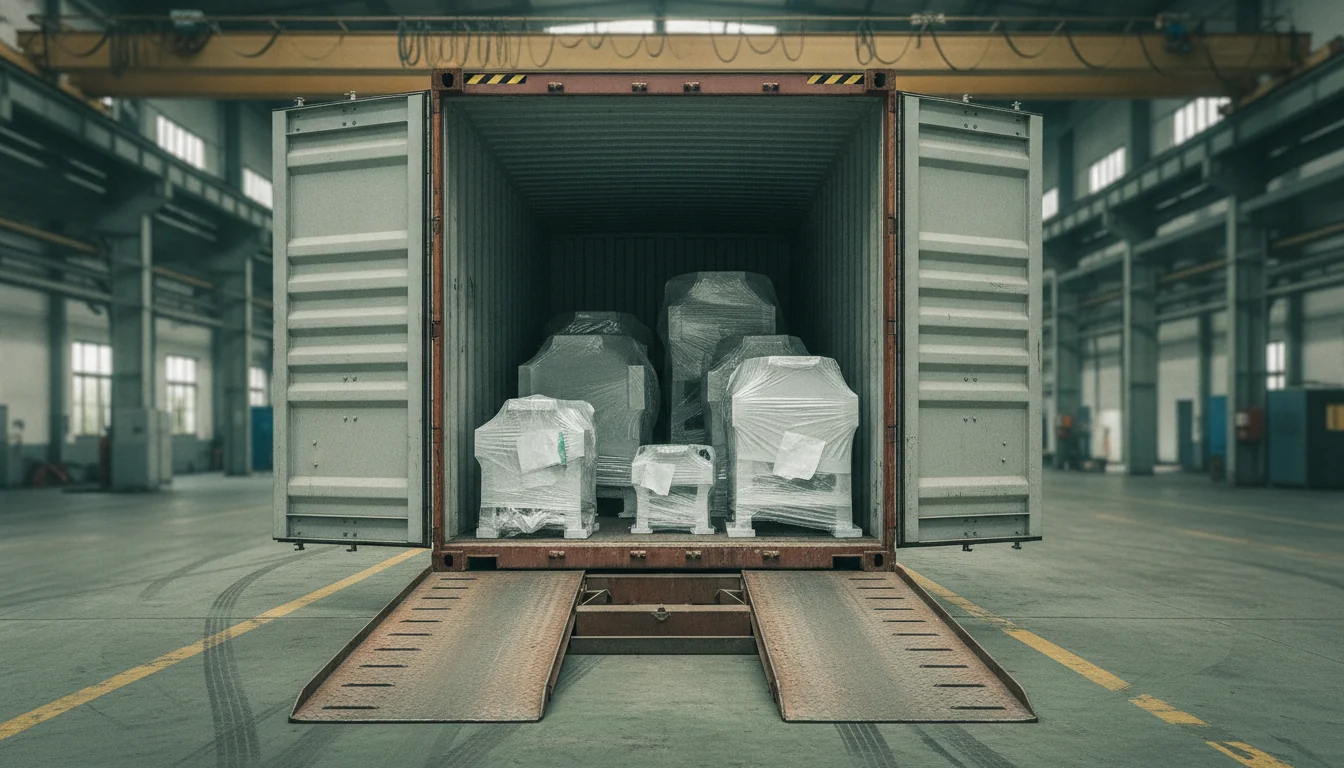
The container is smaller inside than it looks
The published internal dimensions of the standard general-purpose containers are the numbers that matter, not the external ones. A 20 ft general-purpose container measures 5.898 × 2.352 × 2.393 m internally, with a volume of about 33.2 m³ and a net payload of about 28 t. A 40 ft general-purpose container measures 12.032 × 2.352 × 2.393 m, about 67.7 m³ and about 26.5–27 t. A 40 ft high cube keeps the same length and width and raises the internal height to 2.698 m, about 76.3 m³.
The one figure worth committing to memory is the internal width: 2.352 m, the same on all three. A general-purpose container gives 2.393 m of internal height, and the high cube raises that to 2.698 m.
The width limit that decides everything
Mainstream integrated treatment equipment is 2.5–3.0 m wide and 3.0 m high. It will not fit inside any standard dry container, because 2.5 m is already wider than the 2.352 m internal width. Any monobloc unit wider than 2.2 m or higher than 2.3 m has to ship another way: in a 40 ft open-top (OT) or flat-rack (FR) container, by break-bulk vessel, or split at the factory so that no single piece exceeds the container envelope.
The word "containerized" in supplier literature usually means the unit has its own box-like shell and can be lifted and carried. It does not by itself mean the unit fits a standard dry container. Reading the two as the same thing is the most common logistics mistake in a plant purchase, and it is worth settling before the commercial offer rather than after.
Working out how many units fit
Where a unit does fit the envelope, the loading estimate follows a short method. Start from the internal dimensions and deduct the packing and lashing allowance — 0.10 m on each side and 0.15 m on top — to get the effective loading space. Divide by the unit dimensions, taking the floor of the length, the width and the height to get whole units per container. That gives a container count by volume.
Then repeat it by weight. The payload figures above are the practical ceiling: about 28 t for a 20 ft container and about 26.5–27 t for a 40 ft container. Take the smaller of the volume count and the payload count, because treatment equipment is heavy cargo and the weight limit usually binds before the space does.
The order matters. Check the width first, because a unit that is too wide is not a loading problem but a different shipping route. Then check the payload, because a plant that looks small on paper can still exceed a container weight limit once tanks, blowers and structural steel are counted together.
When the answer is not a dry container
If the unit exceeds the dry-container envelope, the options narrow to three. A 40 ft open-top container allows the unit to be lifted in from above and is the usual route for equipment that is over height. A flat-rack carries the unit on a platform with no side walls and no roof, which removes the width limit but exposes the cargo and changes the lashing. Break-bulk shipment on a general cargo vessel removes the container envelope entirely, and is the route for genuinely large monobloc units.
Each option changes cost, schedule and the port handling the cargo needs, so the route should be fixed with the forwarder before a freight rate is quoted. A plant that must travel as one assembled unit and a plant that can be split into modules are two different logistics projects.
Worked through on a containerized plant
Take the packaged range from the containerized product page. The smallest assembled equipment listed is about 3 × 1.5 × 2 m, which sits inside the internal envelope of both a 20 ft and a 40 ft container, so the estimate can be done directly by the method above. The largest is about 16 × 3 × 3.5 m — over the 12.032 m internal length of a 40 ft container, over the 2.352 m internal width, and over the internal height of a high cube. No dry container will take it at all.
That single comparison is the point of the section. Across the range, capacity grows while the shipping method changes, and the change is driven by dimensions rather than by weight or by preference.
What to check before you quote freight
- Internal width against the widest single piece.
- Internal height against the tallest single piece, including any lifting frame or skid.
- Payload against the total weight, not the equipment weight alone.
- Packing and lashing allowance deducted from the internal dimensions.
- Route and port handling available for an open-top, flat-rack or break-bulk shipment.