Industrial waste incinerators for factory and commercial waste.
Dual-chamber industrial incinerators that dispose of non-recyclable factory, warehouse and commercial waste on site, with secondary combustion above 850 °C and a flue-gas purification stage, sized to your daily waste volume and emission standard.
What it is
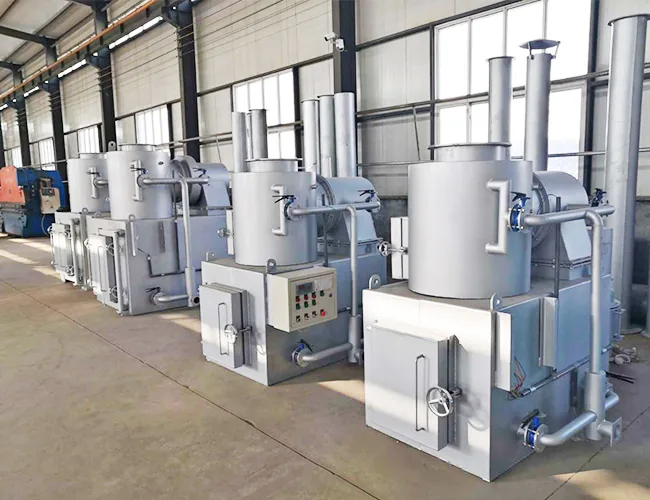
An industrial waste incinerator disposes of the non-recyclable waste a factory, a warehouse or a commercial site produces on the site where it is generated, instead of sending it away for collection. Packaging, pallets, offcuts, textiles, workshop refuse and mixed commercial trash are loaded into a fully enclosed primary chamber and burned; the gases then pass into a secondary combustion chamber held at or above 850 °C with excess oxygen and at least 2.0 seconds of residence time to complete the burn, and the flue gas is cooled and cleaned before it leaves the chimney. Combustion reduces the waste volume by up to 90 % and leaves an inert ash for disposal. The same platform covers factory and commercial waste incinerators, so the unit is built on the dual-chamber arrangement used across our general solid waste range, with the industrial waste burner train, the chamber lining and the flue-gas stage supplied as one complete assembly that needs only a simple concrete foundation.
How it works
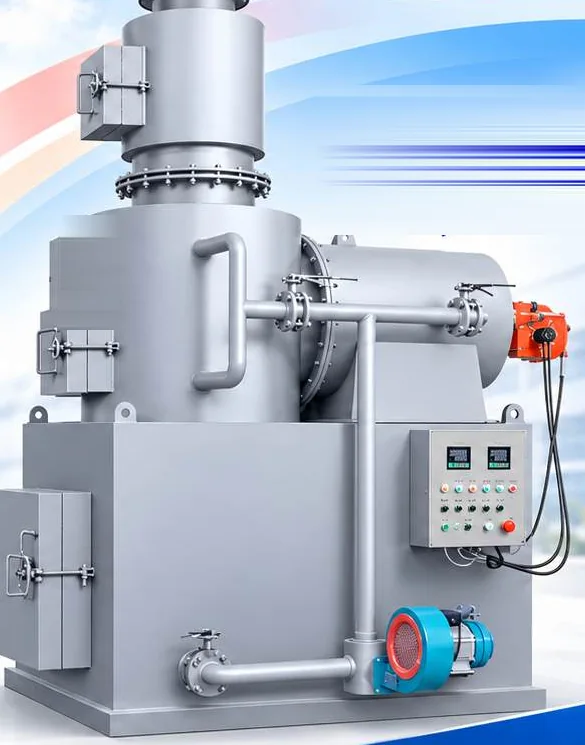
- 1Waste is loaded into the enclosed primary chamber through the charging door, and the chamber is held under negative pressure so no gas escapes during loading.
- 2Primary combustion dries, pyrolyses and partly burns the waste at a controlled temperature, releasing volatile gases and leaving a residual ash.
- 3The gases pass into the secondary combustion chamber, held at or above 850 °C with excess oxygen and a flue-gas residence time of at least 2.0 seconds, completing the oxidation of harmful compounds.
- 4The flue gas is cooled and cleaned — dry purification with Ca(OH)₂ filter bricks, wet purification with quench and deacidification towers, activated carbon adsorption and bag filtration, or the basic single-train configuration.
- 5The cleaned gas leaves through the induced draft fan and the chimney, and the ash is discharged for disposal.
Waste should be segregated before burning: non-recyclable dry material such as paper, cardboard, untreated wood, textiles and packaging is suitable, while batteries, aerosols, solvents and pressurised containers should not be fed to the unit. Combustion figures published for this range: incineration temperature ≥850 °C, flue-gas residence time ≥2.0 s, incineration efficiency ≥99 %. The waste stream and its calorific value decide the burner input and, with the local emission limit, the flue-gas configuration.
Models and specifications
Published data for the XJY general solid waste series, which is the platform used for industrial and commercial waste streams. Where a stream is high in moisture or low in calorific value the model is confirmed against the daily volume and the fuel input; burner and weight data the source does not publish are [to be confirmed with factory].
| Model | Incineration capacity | Unit dimensions (L × W × H) | Waste feeding inlet | Chimney | Induced draft fan | Approximate weight |
|---|---|---|---|---|---|---|
| XJY-50 | 50–100 kg/h | 1.8 × 1.15 × 3 m | 620 × 800 mm | OD φ280 mm | 0.37 kW | 5,000 kg |
| XJY-100 | 100–150 kg/h | 2 × 1.4 × 3.5 m | 760 × 960 mm | OD φ300 mm | 0.55 kW | 8,000 kg |
| XJY-200 | 200–300 kg/h | 2.2 × 1.4 × 3.8 m | 900 × 1100 mm | OD φ400 mm | 0.75 kW | 8,500 kg |
| XJY-300 | 300–400 kg/h | 3 × 2 × 4.8 m | 1080 × 1280 mm | OD φ460 mm | 1.1 kW | 16,500 kg |
| XJY-400 | 300–400 kg/h | 3 × 2 × 4.8 m | 1080 × 1280 mm | OD φ460 mm | 0.75 kW | [to be confirmed with factory] |
| XJY-500 | 400–500 kg/h | 3.3 × 2.3 × 4.8 m | 1080 × 1280 mm | OD φ480 mm | 1.1 kW | [to be confirmed with factory] |
Applications
Factories and workshops
A factory incinerator on this range takes packaging, pallets, offcuts, rejects and general workshop trash, reducing them to ash on the premises instead of accumulating them for a collection round.
Warehouses and logistics sites
Damaged goods, packing material and non-recyclable commercial trash from a distribution site are disposed of inside the boundary.
Commercial premises
Hotels, markets, malls and transport hubs use a commercial trash incinerator for the general refuse a collection service will not take.
Industrial parks
Non-recyclable general and hazardous waste from manufacturing tenants is burned inside the park, with the flue-gas configuration matched to the local limit.
Remote and island sites
Mining camps, construction sites and island facilities with no reliable collection chain dispose of their own waste on site.
Transfer and treatment yards
Residue and rejects left after sorting and recycling are reduced in volume before the remaining ash goes to landfill.
Emissions and configuration
Three flue-gas configurations are offered on this range. Dry purification passes the gas through Ca(OH)₂ filter bricks after secondary combustion and is the standard choice where the local limit is met by dry scrubbing. Wet purification adds a multi-stage train — quench cooling tower, deacidification tower, activated carbon adsorber and bag dust collector, with a venturi scrubber and cyclone in the wet-type arrangement — for stricter limits. The basic configuration is a single compact combustion train without the wet stages. Which configuration applies is decided by the waste stream and the emission standard at the site, not by the model alone. Fuel can be diesel, natural gas or LPG according to what is available locally, and the burner train is matched to the calorific value of the waste being burned.
| Incineration temperature | ≥850 °C |
|---|---|
| Flue-gas residence time | ≥2.0 s |
| Incineration efficiency | ≥99 % |
| Residue loss on ignition | ≥5 % as published [to be confirmed with factory] |
| Operating voltage | 380 V or 220 V |
Emission limits and the applicable test standard are confirmed per project against the local regulation. Values that carry a placeholder are not published for this model and are [to be confirmed with factory].
Questions buyers ask
What can an industrial waste incinerator burn?
Non-recyclable dry and mixed material. On a production site an industrial garbage incinerator is normally asked to take packaging, cardboard, pallets, untreated wood, textiles, production rejects and general refuse, and an industrial trash incinerator at a warehouse takes the same list plus damaged goods and packing material. Wet food waste, liquids, batteries, aerosols, solvents and pressurised containers are excluded — liquids and closed containers are a safety risk in a chamber of this type, and wet material is what drives fuel consumption up.
How do I compare industrial waste incinerator manufacturers?
Ask each supplier for the same five things: the published combustion figures (chamber temperature, flue-gas residence time, incineration efficiency), the flue-gas train that comes with the unit rather than as an option, the model dimensions and weight, the waste streams the unit is rated for, and reference installations running the same waste. A quotation that lists a capacity without a residence time and a gas-treatment stage is not yet comparable.
Where are industrial waste incinerators for sale, and how are they shipped?
Units are built to order rather than held in stock: an industrial waste incinerator for sale from our works is quoted for the model, the flue-gas configuration and the fuel that apply at your site. The unit is built and tested before shipment and travels as a complete assembly with export packing; loading arrangement, container count and delivery schedule are confirmed per order [to be confirmed with factory].
How is an industrial incinerator sized?
On the daily waste volume and on the calorific value of what is burned, not on a peak hour figure — most sites generate waste in batches rather than continuously. The model is then chosen from the range, and the chamber, the burner input and the flue-gas stage follow from it. Where the waste mix varies through the year, size on the heavier month and confirm the model with the factory.
Do I need flue-gas treatment?
The configuration follows the regulation in force at the site. Where dry scrubbing meets the local limit, Ca(OH)₂ filter bricks after secondary combustion are enough; stricter limits call for the wet train — quench cooling, deacidification, activated carbon adsorption and bag filtration. The gas-treatment stage is supplied with the unit rather than bought separately, so the compliance route is fixed before the order rather than after installation.