Animal carcass incinerators for farm and livestock disposal.
Dual-chamber animal incinerators that dispose of dead livestock and poultry on the farm, with secondary combustion above 850 °C and a flue-gas purification stage, sized to your daily carcass volume and emission standard.
What it is
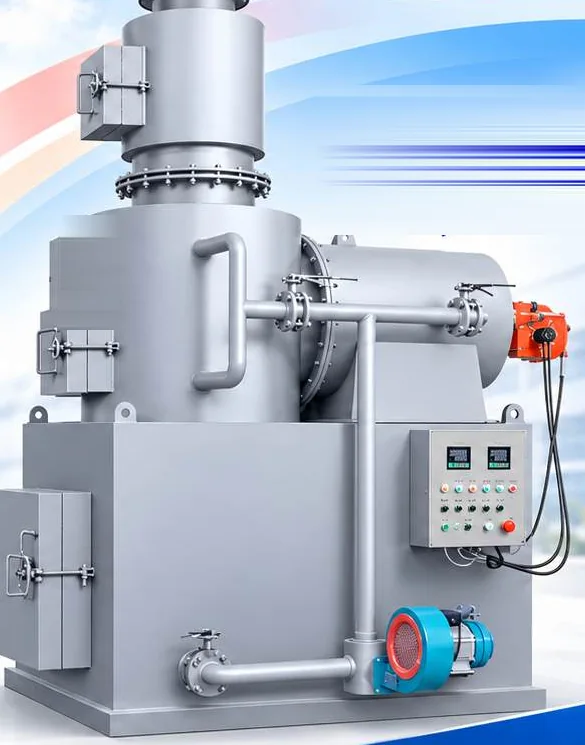
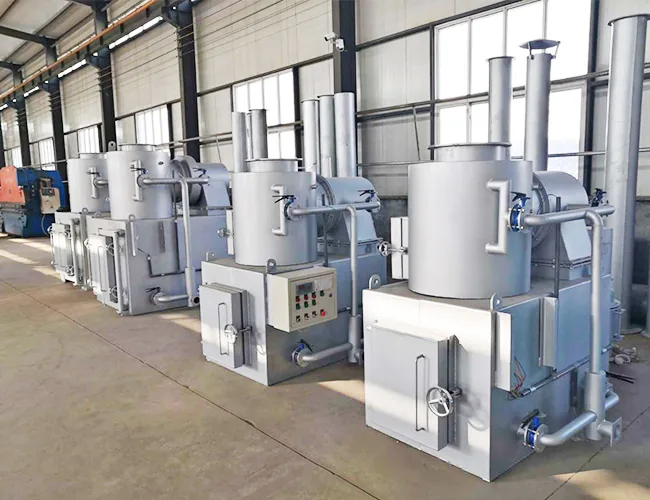
An animal carcass incinerator disposes of dead animals on the site where they are kept, instead of holding them for a collection service or a rendering plant. Carcasses are loaded into a fully enclosed primary chamber and burned; the gases pass into a secondary combustion chamber held at or above 850 °C with excess oxygen and at least 2.0 seconds of residence time to complete the burn, and the flue gas is cooled and cleaned before it leaves the chimney. High-temperature combustion destroys pathogens and reduces the material to a small volume of inert ash, so the carcass does not have to leave the premises. The unit is built on the same dual-chamber platform as our general solid waste range, and the fully enclosed chamber, the negative-pressure loading and the flue-gas stage are supplied with the unit. A dead animal incinerator of this type is placed away from the sheds and the feed store on a simple concrete foundation, and it closes the gap between the moment a carcass is found and the moment it can be dealt with: an animal waste incinerator on the farm removes both the holding time and the biosecurity risk of moving material along a public road.
How it works
- 1Carcasses are loaded into the enclosed primary chamber through the charging door, and the chamber is held under negative pressure so no gas or odour escapes during loading.
- 2Primary combustion dries and pyrolyses the material at a controlled temperature, releasing volatile gases and leaving a residual ash and bone residue.
- 3The gases pass into the secondary combustion chamber, held at or above 850 °C with excess oxygen and a flue-gas residence time of at least 2.0 seconds, completing the oxidation of harmful compounds and destroying pathogens in the gas stream.
- 4The flue gas is cooled and cleaned — dry purification with Ca(OH)₂ filter bricks, wet purification with quench and deacidification towers, activated carbon adsorption and bag filtration, or the basic single-train configuration.
- 5The cleaned gas leaves through the induced draft fan and the chimney, and the ash is discharged for disposal.
The chamber is sized on the daily carcass volume, which is burned in batches rather than as a continuous flow. Combustion figures published for this range: incineration temperature ≥850 °C, flue-gas residence time ≥2.0 s, incineration efficiency ≥99 %. Loading arrangement and ash handling are confirmed with the factory for the model and the site.
Models and specifications
The XJY general solid waste series is the platform used for carcass disposal, and the published data below is for that series. Model selection is confirmed against the daily carcass volume, the carcass size that has to pass the charging door and the regulation in force at the site; animal-specific throughput and burner data are [to be confirmed with factory].
| Model | Incineration capacity | Unit dimensions (L × W × H) | Waste feeding inlet | Chimney | Induced draft fan | Approximate weight |
|---|---|---|---|---|---|---|
| XJY-50 | 50–100 kg/h | 1.8 × 1.15 × 3 m | 620 × 800 mm | OD φ280 mm | 0.37 kW | 5,000 kg |
| XJY-100 | 100–150 kg/h | 2 × 1.4 × 3.5 m | 760 × 960 mm | OD φ300 mm | 0.55 kW | 8,000 kg |
| XJY-200 | 200–300 kg/h | 2.2 × 1.4 × 3.8 m | 900 × 1100 mm | OD φ400 mm | 0.75 kW | 8,500 kg |
| XJY-300 | 300–400 kg/h | 3 × 2 × 4.8 m | 1080 × 1280 mm | OD φ460 mm | 1.1 kW | 16,500 kg |
| XJY-400 | 300–400 kg/h | 3 × 2 × 4.8 m | 1080 × 1280 mm | OD φ460 mm | 0.75 kW | [to be confirmed with factory] |
| XJY-500 | 400–500 kg/h | 3.3 × 2.3 × 4.8 m | 1080 × 1280 mm | OD φ480 mm | 1.1 kW | [to be confirmed with factory] |
Applications
Poultry houses and broiler farms
A poultry incinerator on site handles routine mortality and spent birds without a collection round, and keeps the material away from the sheds.
Livestock and cattle farms
A livestock incinerator disposes of dead animals from the herd on the premises, sized on the number of head kept and the volume the unit has to absorb.
Sheep and goat farms
A sheep incinerator suits smaller operations where the daily volume is low and irregular, with the chamber run in batches.
Hatcheries and breeder operations
A chicken incinerator close to the hatchery handles culled chicks and routine mortality where it occurs rather than moving it off site.
Mixed holdings
An incinerator for farm use takes both duties on one unit: a farm animal incinerator for poultry and small stock, and a farm garbage incinerator for the general waste that has no landfill route.
Remote and island livestock sites
Farms far from a rendering plant or a collection service dispose of carcasses on site rather than transporting them.
Emissions and configuration
Three flue-gas configurations are offered on this range. Dry purification passes the gas through Ca(OH)₂ filter bricks after secondary combustion and is the standard choice where the local limit is met by dry scrubbing. Wet purification adds a multi-stage train — quench cooling tower, deacidification tower, activated carbon adsorber and bag dust collector, with a venturi scrubber and cyclone in the wet-type arrangement — for stricter limits. The basic configuration is a single compact combustion train without the wet stages. Which configuration applies is decided by the material being burned and the emission standard at the site, not by the model alone. Fuel can be diesel, natural gas or LPG according to what is available locally.
| Incineration temperature | ≥850 °C |
|---|---|
| Flue-gas residence time | ≥2.0 s |
| Incineration efficiency | ≥99 % |
| Residue loss on ignition | ≥5 % as published [to be confirmed with factory] |
| Operating voltage | 380 V or 220 V |
Emission limits and the applicable test standard are confirmed per project against the regulation in force at the site. Values that carry a placeholder are not published for this model and are [to be confirmed with factory].
Questions buyers ask
What can an animal carcass incinerator dispose of?
Dead poultry and livestock — birds, sheep and other small stock, and animals from the herd — together with the animal waste produced in the same operation. Material is burned in batches and the ash that remains is removed for disposal. Additional applications can be confirmed with the factory.
How is a dead animal incinerator sized?
On the daily carcass weight and the number of animals kept, rather than on a peak figure. Poultry houses and livestock farms generate disposal in batches, so the chamber is sized so that a normal day can be burned in one or two loads, with the model confirmed against the carcass size that has to pass the charging door. Carcass-specific throughput data is [to be confirmed with factory].
Why incinerate on the farm rather than use a collection service?
On-site disposal removes the holding time between a carcass being found and it being collected, and it removes the biosecurity risk of moving material along a public road. Incineration of animal carcasses on site also reduces what has to leave the premises to a small quantity of ash.
Do poultry incinerators need flue-gas treatment?
On this platform poultry incineration uses the same gas train as the general solid waste range, and the configuration follows the regulation in force at the site. Where dry scrubbing meets the local limit, Ca(OH)₂ filter bricks after secondary combustion are enough; stricter limits call for the wet train — quench cooling, deacidification, activated carbon adsorption and bag filtration. The gas-treatment stage is supplied with the unit rather than bought separately.
What is an incinerator for animal disposal rated on, and how do poultry incinerator prices compare?
A carcass incinerator is rated on the daily carcass weight and the animal size the chamber has to accept, and price and cost follow the model size, the flue-gas configuration, the fuel and the site works. Because the model is matched to the carcass volume rather than sold from a stock list, poultry incinerator prices and animal incinerator cost are quoted per project with the model given in the offer.
Can I buy an animal incinerator for sale to a farm overseas?
Units are built to order rather than held in stock, so an animal incinerator for sale is quoted for the model, the fuel available locally and the emission standard that applies in your country. A poultry incinerator for sale for a single house and a livestock incinerator for a larger herd are configured from the same range, then built, tested and shipped as a complete assembly with export packing; loading arrangement and delivery schedule are confirmed per order [to be confirmed with factory].